Tails From Provence
What happens when a horsemad Ould Wagon moves from Cork to Provence with 2 horses, 2 dogs and a Long Suffering Husband? Why, she gets a third dog, discovers Natural Horsemanship à la Française, starts writing short stories and then discovers a long-buried talent for art, of course…

The Third and Final Experimental Irrigation System
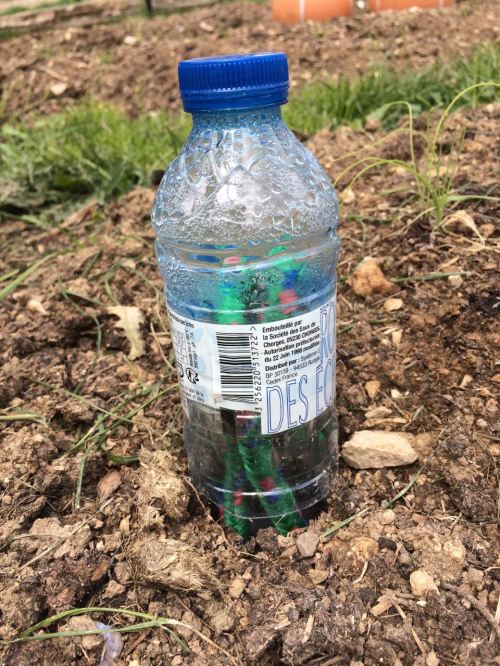
I put this picture at the end of Growing Water Bottles as a teaser, to see if anyone would guess what our third irrigation system would be. The Horse Mad Scientist suggested it was a mini-cloche. Good guess, but WRONG! I have used large 5L water bottle as cloches before, mind you. They worked really well – cut the tops off and sit them over the tender plants at night time or when the weather is cold. Another use for your waste plastic!
Anyway, if you look closely at the photo above, you’ll see that the green things inside the little bottle are actually pieces of rope.
Those pieces of rope – there’s two in this case – are sitting in a bottle of water. They are fed out through the top and go immediately underground. They’re approximately 3cm below the surface, and they travel for a distance of about 50cm, in two nice parallel lines. Water wicks along the length of the rope from the bottle, providing a slow, steady feed of water to the surrounding soil. I’m quite certain this works – I tested the rope for wickability on a bought-in basil plant some time ago, and it worked really well – too well, in fact, on the days when the sun didn’t shine. I’ve left the ends of the rope sticking out of the ground, so I can check that they are damp any time I’m worried that my plants are not getting enough water. By pure chance, this little plastic bottle fits perfectly over the point where the ropes emerge from the bottle and I’m using it to block evaporation at that point.
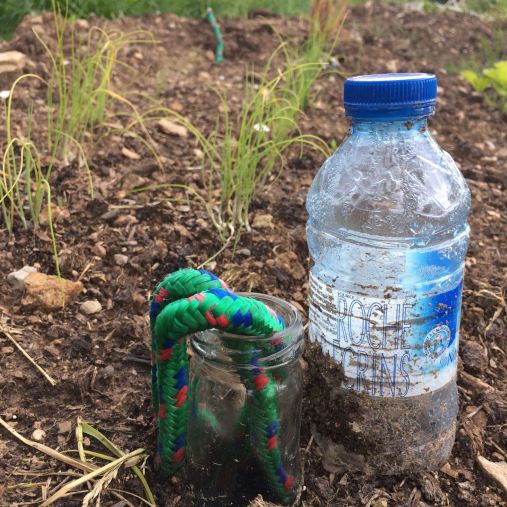
Disassembled! You can see the two lines of Welsh onions behind, and a piece of rope sticking up at the end
Sitting on top of the buried ropes are two lines of Welsh Onions, Ciboulette Ishikura in French, which is supposedly halfway between a leek and a scallion. I’ve never had them before, but the description on the packet made them sound very good so I planted the first lot of seeds some time ago and moved them outside at the end of April. I sowed a second line beside them at the same time, having planted the rope beforehand, mind you!
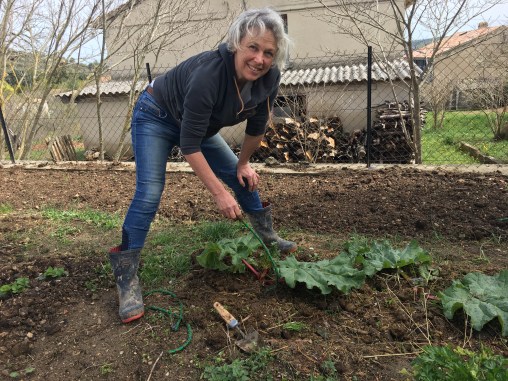
Planting ropes around the rhubarb
I’m using the same system in the rhubarb patch.
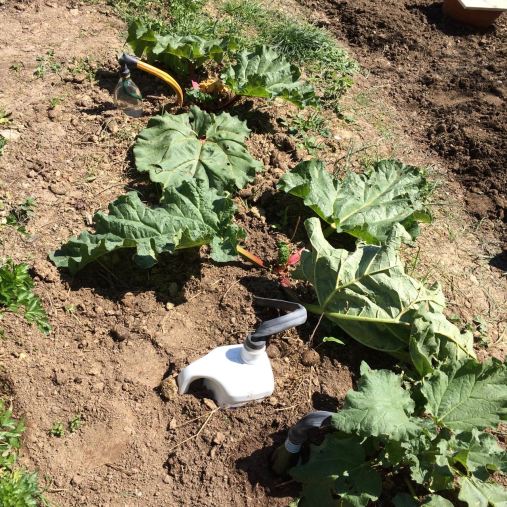
The full rhubarb set-up
At the time when I set up these ones, I was struggling to find enough containers to use, so it’s a bit Mix ‘n’ Match – there’s a 75cl bottle at the bottom, a 3L bottle in the middle and a 1L bottle at the top. I will become more consistent over time, I swear! Three 3L bottles would be great here, I would have to refill much less often.
I’m using a different method to stop evaporation here. I’ve stretched pieces from an inner tube over the bottle caps, attached them to a short piece of hosepipe, fed the buried rope through the whole lot, screwed on the caps and buried the ends of the hosepipe pieces in the ground.
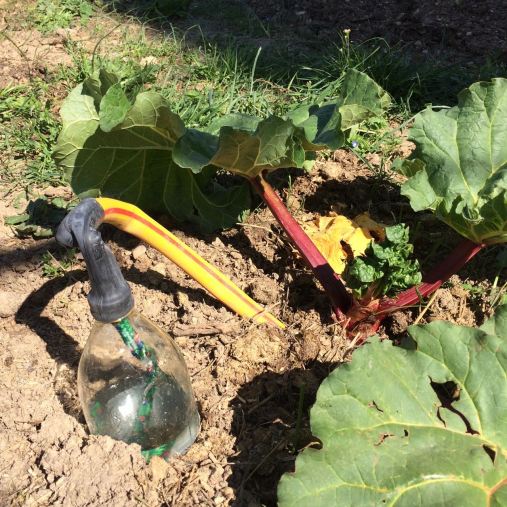
A closer look at the bottle top/inner tube/hosepipe arrangement
This particular installation is working really well. The rhubarb looks fantastic and I can now say it tastes great too – we had our first sample of it the other day when I made a rhubarb crumble to bring to our neighbours’ for lunch.
This is a really good system for providing a slow, steady feed of water. If you are more organised than me and collect 3L and 5L bottles over the course of the winter, you’d have a set-up which could last for a week easily without adding water. However, I feel it’s probably best suited to plants that don’t like to send out deep roots, so in my test cases the rhubarb and Welsh Onions seemed the best candidates for this one.
There are two final irrigation systems ready for use in my potager.


But there’s nothing experimental about these. These are for refilling bottles, clay pots and also for In Case one of the other systems is a total failure.
And now my neighbour tells me that this is going to be a wet year so perhaps I’ve set all this up for nothing. But we’ll see!
Where’s your Irish Pride?
Everyone is telling us that there’s no point in growing spuds here. And I mean EVERYONE.
Irish Eddie, who’s been living here since long before Peter Mayle made it fashionable, is a seasoned potager cultivator, along with his wife, French Áine, who’s big into permaculture and all things organic. Eddie, being Irish, missed the typical floury spuds that graced the Ballyvolane table back in the day, so he tried to grow them. And tried and tried and tried. The Colorado Beetle was his biggest enemy and, eventually, he gave up.
Welsh Daithí is, like myself, a veteran of vegetable growing on the British Isles. His house is perched on the bony skeleton of a nearby mountain. Barely enough soil to grow lichen on… he made some raised beds, filled them with the best organic compost he could buy, and planted his seed potatoes. He had the healthiest, most beautiful potato plants he had ever seen. They sprouted, grew to impressive proportions, flowered and died back, all on schedule, The day came to harvest his crop. He dug in with bated breath….
One potato. About the size of a glassialley (large marble). He’d have been better off eating the seed potatoes.
Long-time blog follower The Horse Mad Scientist told me her tale of potato cultivation in an area that seems to have a climate similar to ours. Copying from the comments section of We’re Growing Pot :
I tried growing “German Butterball” potatoes the last two years, in pots (plastic). I did everything I was told to…lots of c, thoroughly composted manure (which, I learned, is what gives the skins a wrinkly texture), good soil, I hilled them up to the undersides of the first set of leaves, kept them watered and babied them unbelievably. The result? Well…lots and LOTS of teeny little potatoes. The largest ones, with one gigantic exception, were no more than the size of your curled palm. The rest were the size of a small marble. You really can’t do much with that.
The giant sized one was enormous. Spread your fingers out wide like you were going to hold a big rock, and put them finger tip to finger tip with a gap of about an inch…and that was the size of it. But, when I cut it open it had ‘”hollow heart”. It was hollow on the inside. In fact, the interior hollowed part had exterior skin growing on the surface…so it was growing outside in. It too was fairly worthless.
So I’ve given up on potatoes. Good luck, though!
French Seoirse has been cultivating his potager for years and years. I offered him the remainder of my seed potatoes. Non non non non… he could not get the ‘nons’ out fast enough. He laughed at my notion of growing potatoes down here. It’s not the right climate. Or the terrain, apparently.
But they grow potatoes in the Israeli desert and in lots of other non-temperate regions of the world. So I’m giving it a shot.
The pride of Ireland as a potato growing nation rests upon these puny (albeit Dutch) shoulders.

Variety Bintje. The least waxy potato we have managed to find here.
COME ON YE BOYS IN GREEN!
Growing Water Bottles
Continuing with the gardening theme :
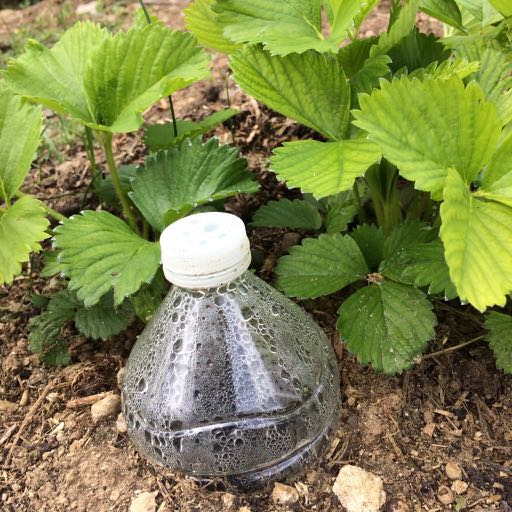
In addition to planting pots, I’ve also been planting plastic bottles.
These ones are for watering strawberry plants. I’ve got an established bed of strawberries (well, it’s one year old) and a new bed of strawberries, containing eight baby plants. In the latter, I actually planned what I did (for once in my life). So these bottles are nicely spaced out, one for every two plants, with water coming out evenly on each side – hopefully.

I poked holes down two sides of each bottle, using a red-hot pin (heated over a candle. I’m pretty low-tech). I also poked a couple of holes in the bottom of each bottle, to allow water to fully drain from them every time they’re filled up. Bottles are planted right way up, and the tops are cut off for ease of filling, but placed upside-down in the planted bottles to stop creepy-crawlies from setting up home and to reduce the amount of soil and debris that can fall in and start blocking up the holes. Up to now, they have been filled by watering can, but soon I will progress to using a hose to top them up – when the rain stops, the ground dries out and I connect a hosepipe to my new water tank!
In the older strawberry bed, I have some plants which were purchased and some plants which are ‘volunteers’ – children grown from runners sent out by the adult plants. So they’re rather scattered, and the planting of plastic bottles had to be equally higgledy-piggledy in order to try and distribute some water to every plant.
 It’s not so pretty and organised, but hopefully these guys have a strong enough root system that each plant will be able to take advantage of a nearby bottle.
It’s rained a bit over the past few days, and it’s expected to rain on and off for the next week, so watering will not be on my to-do list. However, during a recent warm, dry spell, I was refilling the bottles every two days. The older plants seemed happy with this, but one of the baby plants started to go into a state of collapse one hot afternoon, so I took to giving all the babies a sprinkle on the surface every time I filled the bottles. Once this damp spell passes, I hope they won’t need assistance any more.
The proper name for this system is “vertical pipe irrigation.” The idea is that water is carried directly to the root area, so there is no wetting of the soil surface and consequently almost no loss due to evaporation. It’s usually associated with planting young trees in a dry area, but I think it will suit the strawberries. They can be very thirsty while they’re fruiting, but they don’t have a particularly deep root system. So far, the plants are looking very healthy, with plenty of flowers and a few berries already on the way so I’m quietly confident about this one. My one concern is our very hard water – I suspect the pin-holes will become bunged up with a deposit of lime. I guess it will depend on how much tap-water I use, as opposed to rain-water (3,000 litres stored as I type. Woohoo!).
A side benefit of this system is that it’s a way of re-purposing what were originally single-use plastic bottles. We’ve cut down our plastic consumption so much that we had to beg, borrow and steal bottles for this experiment.
I’m experimenting with a total of three ‘alternative’ irrigation systems. In my last post, I introduced the clay pot irrigation system, from which I’m expecting variable results depending on the individual pots. There is a huge “Hmmm” in my mind about that one, to be honest, and I suspect I may replace some of my cheap-o terracotta plant pots over the next few weeks. I may even choose to swap some out for plastic bottles. We’ll see. But the good news from the clay pot bed is that we have a couple of potato plants showing their little faces.
Finally, here’s a hint about the third irrigation system I’m trialling :
 Anyone want to guess what’s going on here?
Next in series : The Third and Final Experimental Irrigation System
Previous in series : We’re Growing Pot
Have a look at my Art!


Commissions


 Tails From Provence