Tails From Provence
What happens when a horsemad Ould Wagon moves from Cork to Provence with 2 horses, 2 dogs and a Long Suffering Husband? Why, she gets a third dog, discovers Natural Horsemanship à la Française, starts writing short stories and then discovers a long-buried talent for art, of course…

Diary of a Chronic Abscess
(Also know as Aero’s Diary)


I diligently soaked Aero’s foot in a Cider Vinegar solution for two days, then the Clean Trax solution arrived in the post and I settled down to treat Aero with it on Thursday morning. I decided to soak his foot for an hour this time, so we settled down for the long haul, Aero munching on his hay net, Dylan waiting patiently outside the stable door and me playing Sudoku on my phone, while making sure Aero didn’t move around and risk pulling the soaking boot off.
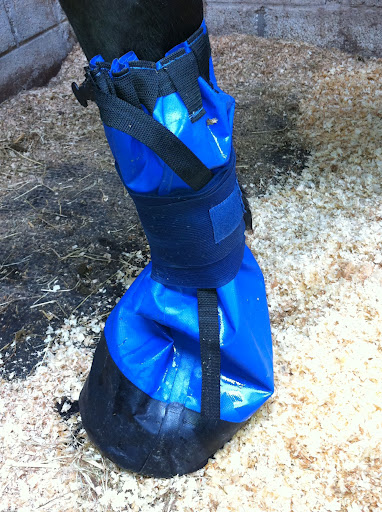
 After the hour was up, I carefully followed the Clean Trax instructions and bandaged a plastic bag onto his foot, leaving it there for a further 45 minutes “to allow the vapours to permeate the hoof.” Ok, so, job done.
I kept him in overnight and checked him the following morning. It looked good – the abscessed foot (left front) was no longer noticeably hotter than the others, the glands in his throat seemed to have reduced and most importantly, I asked him to trot for a few strides up the drive towards the yard and he seemed ok.
Cue Saturday morning. This was the day I was going to check him out fully – I actually felt I would jinx his recovery if I trotted him up properly on Friday, so I decided to give him an extra day to improve once I thought I’d seen some improvement.
I touched the heel of the left front. Hot. I touched the heel of the right front. Much, much cooler. I held the palm of my hand over the front of the left hoof. Definitely warm. I held the palm of my hand over the front of the right hoof. Definitely cool. Once again, the glands in his throat were up. Once again, he was lame at walk. Once again, back to the drawing board.
It was time for some reflection. I came to the conclusion that I screwed up big time the day the chunk broke off his hoof. At that stage, I should have poulticed the hole left by the break for a couple of days and I should then have kept his foot as clean as possible, ie bandaged and protected from dirt and re-infection for as long as it took – probably weeks. Instead, I took the “Ah, sure it’ll drain away by itself in the field” approach, and turned him out into my paddock. This might have worked if we were having anything approximating a normal summer here, but with the huge quantities of rain we’ve been having, large tracts of my paddock are under water. Because of this, Aero has had no choice but to slosh around in mucky water, and instead of the infection in his foot draining out, more dirt and infection worked their way in. When I thought about it, if the Hoof Stuff packing material and PHW resin wrap allow moisture to flow out, then it follows that bacteria and infection can flow in too.
My initial reaction was to cut off the PHW wraps, clean out the hole where the break occurred and start poulticing and bandaging from scratch. I even went out and bought a sheet metal snips just to cut off the wraps! Then when I brought Aero in from the paddock and scrubbed his foot, I noticed a soft pink spot at the back of his heel. Could I focus on this point and get the abscess to break through?

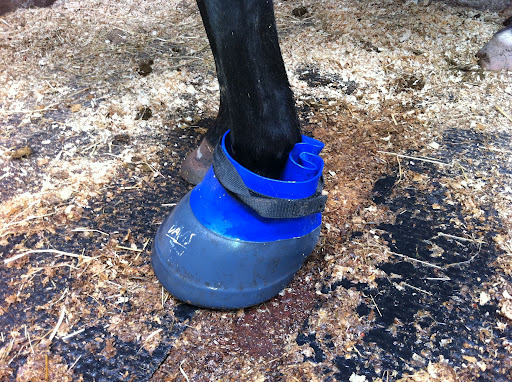
I shelved the Snipping plan for the moment, pulled out the Davis boot and started hot-tubbing with salt water. Then I applied an Animalintex poultice, bandaging it onto his hoof and protecting it with one of Flurry’s Cavallo Sport Boots. I was hoping to find the poultice full of pus that evening, but no such luck.
Hot-tubbed again with the Davis boot, applied the poultice again. Same story on Sunday morning, a disappointingly clean poultice.
Lather, rinse, repeat.
Please let it end soon.

Aero’s Diary
Unfortunately, this has turned into “Diary of a Chronic Hoof Abscess.”
As expected, a chunk of Aero’s hoof wall sheared off, just the day before Anja the AEP practitioner was due to call.
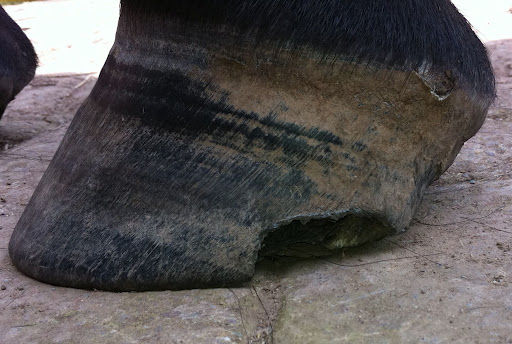 |
| The missing chunk. You can also see where the abscess broke through at the coronet |
I cleaned it and soaked his foot in a bucket of Epsom salts, but it is quite badly damaged and you can see that the weakness continues upwards through the hoof near the heel.
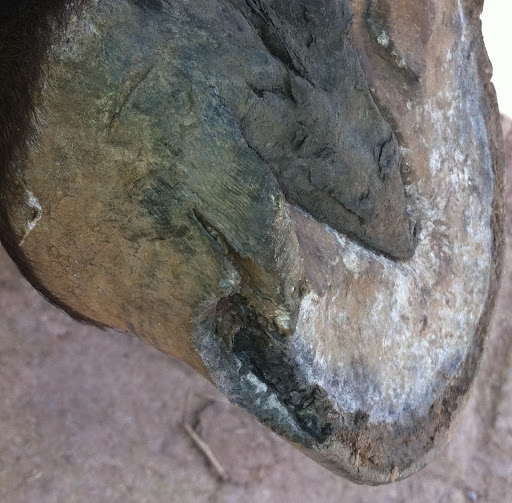 |
| You can see the crack continues up the hoof wall |
The good news, though, is that any pus should be able to drain away quite easily now, but the bad news is that being so open, it’s very susceptible to re-infection.
When Anja called the next day, she tidied up the break, cleaned the opening and stuffed it with Hoof Stuff, which is made from honey, Zinc Oxide and cotton wool. It adheres to the cavity, aids healing, allows drainage and acts as a barrier while the hole is growing out. Hope it works!
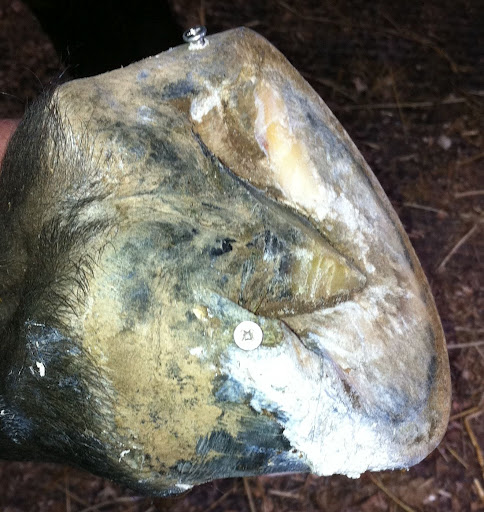 |
| Crevice cleaned and stuffed, the screws are to hold the resin bandage in place |
Aero was clearly still very sore on this foot, and our conclusion was that the sole is having to carry too much weight because there is no hoof wall at that point. She felt that putting him back in PHW wraps would benefit him and help to support the weakened hoof wall, while at the same time allowing normal circulation to continue, allowing the hoof to breathe and enabling me to soak it or Clean Trax it as necessary.
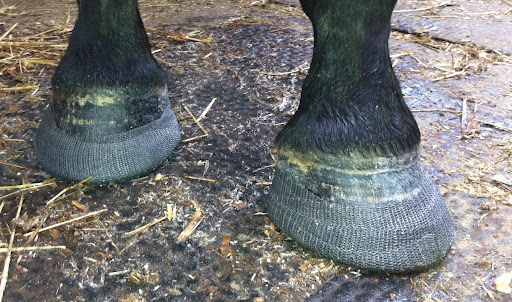 |
| All wrapped up |
Initially, he has been very sore, not quite on three legs but not far off it. There is still significant heat in this foot, centred at the heel. I am planning to Clean Trax it just as soon as I get my hands on a bottle (tomorrow hopefully) because I suspect that the solution I used last week was gone off – it’s supposed to be kept in the fridge, but that bottle had travelled around France with us for four weeks.
I’ve also been reading up about abscesses on various forums. The current thinking really seems to be “let it drain by itself” and to use Epsom Salts or Cider Vinegar (a new one on me) in a solution to soak the foot. Having already spent a week soaking his foot in Epsom Salts, I think I will try the Cider Vinegar this time.
Any other suggestions will be gratefully received. It is so hard to see him in pain all the time, he’s a sweet boy and he doesn’t deserve this.
Swansong?
It’s entirely possible that I’ve just competed in Ireland for the very last time, unless the whole France thing doesn’t work out and we come back next year with our tails between our legs.
I’m sad about that, but otherwise I couldn’t be happier about today.
It started at 6.40am, when I hauled a fat, contented Flurry in from the paddock with really long grass, which he had broken into overnight. No feed for him, then, the little glutton. I washed his mane, tail and fetlocks, sprayed his tail with loads of Mane&Tail conditioner, plaited his mane and spent AGES going through his tail, but it was worth it, it looked gorgeous afterwards. I gave him a small amount of haylage to keep him happy while I went in for my brekkie – well, I couldn’t let the poor little guy get hungry, could I?
 |
| Warming up, fetlocks blowing in the breeze |
We arrived at our show venue, Maryville, in good time, tacked both of us up and headed to the warm-up. Flurry didn’t feel great warming up, it was busier than he’s used to and he was a bit intimidated by the other horses. He was also lazy and a bit inattentive, so I was doing transitions and leg-yielding to try to sharpen him up, but I still wasn’t too happy with him when we were called up for our first test, BD Prelim 12.
Time for one more mental rehearsal before we went in, time for a little trot around outside the boards, throw in a few transitions, and Enter at A…
I felt it was accurate and obedient, but a little sluggish. Accuracy is usually a good sign – you can’t ride an accurate test if the horse is inattentive, too onward bound or too lazy. I guessed my score would be low sixties, but I wasn’t too sure. Here’s the video :
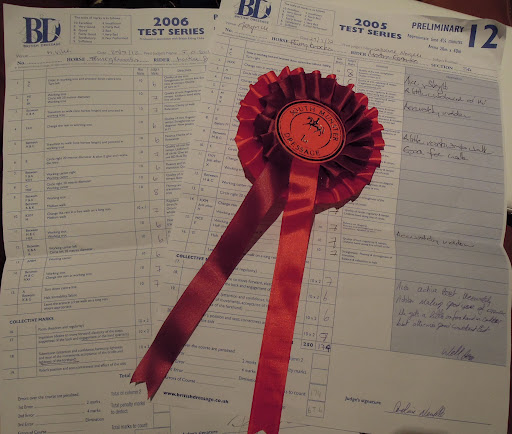
I was astounded when I saw my score – 69.6%, the third highest score in all of test 12, and the winning score in my section! The judge’s comments were “Nice active test, accurately ridden making good use of arena. He gets a little on forehand in canter but otherwise good consistent test.” Woohoo!
I had a quick look at the video afterwards, and I have to say, it looks better than it felt! Yeah, the canter still isn’t great, I think the judge was a wee bit kind to me, but the trot work looked good throughout.
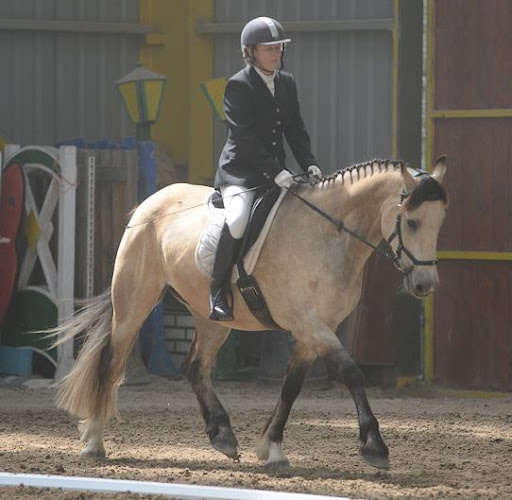 |
| Here we go for the second test |
I was determined to improve the impulsion for the next test, BD Prelim 14, but at the same time I didn’t want to overcook him in the warm-up, so I carefully allowed 25 minutes to tack up and warm up again. When we arrived back at the trailer, though, we found he had covered his formerly lovely tail with liquid, grassy poop – yuck! There was nothing I could do except shake most of it off and hope the rest would fall off during our warm-up!
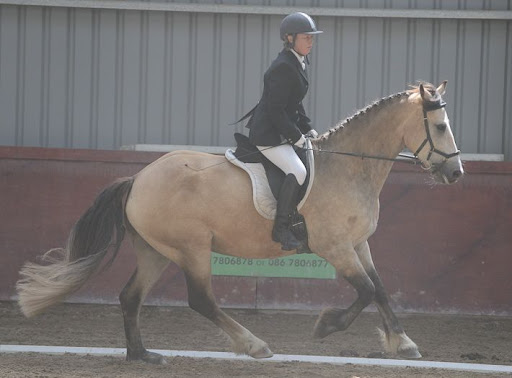 |
| Look at that tail! |
This time there was no video, the LSH was taking stills instead, and having seen them, I have to say it doesn’t seem to have been as good as the first test. In looking for more impulsion, I lost consistency in his outline and the transitions did not flow as smoothly. The score? 64.58%, still a score to be proud of as far as I’m concerned, and once again, the winning score in my section. The judge’s comments this time were “Overall calm, obedient test. Needs to be more active in trot work and lighter on forehand in canter.” Yes. I agree with all that.
So since completing our 500km trek across France, Flurry and I have competed twice in dressage and have managed to score over 63% on each occasion. What’s so special about 63%? That’s the qualifying mark for our National Championships – we’re now qualified for the Sportsmans A finals (an amateur section), but the bad news is I probably won’t be able to go – we’ve just got too much to do before we leave for France.
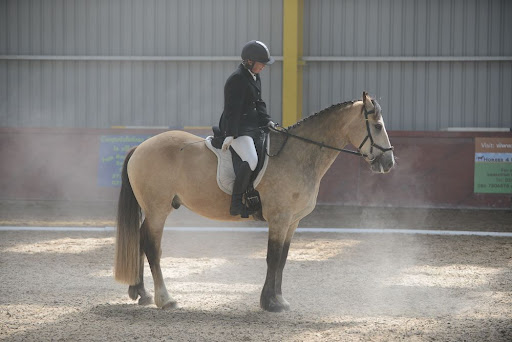 |
| Halt, Salute and… |
Oh well, at least we qualified. I’m very proud of my little horse!

Have a look at my Art!


Commissions


 Tails From Provence