Tails From Provence
What happens when a horsemad Ould Wagon moves from Cork to Provence with 2 horses, 2 dogs and a Long Suffering Husband? Why, she gets a third dog, discovers Natural Horsemanship à la Française, starts writing short stories and then discovers a long-buried talent for art, of course…

Aero’s Diary
Heuston, we have Saliva!
I’ve been ticking over with Aero all week. He had his feet trimmed on Monday, so on Tuesday I put boots on his front feet (I only have two boots which fit him) and we did a 25-minute walk down the road. This ended up with him getting so excited about a scarecrow that he completely forgot about his tender and unbooted hind feet for at least five minutes, which didn’t do him any good at all, so I resolved to stick to the arena for the next couple of days.
On Wednesday, I played with saddles. I dug out his Bates Isabell saddle and put it on him with nothing underneath – it was definitely tilting to the back.
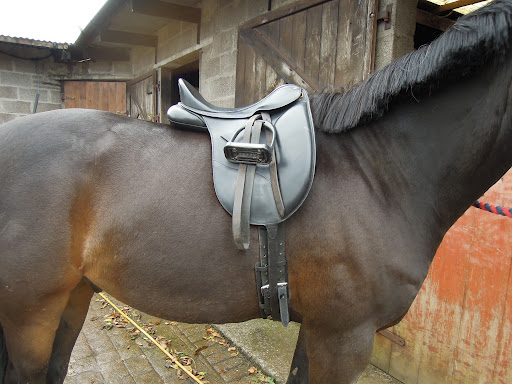
I put my nice new but not-so-shiny-anymore riser pad underneath, and it looked pretty good.
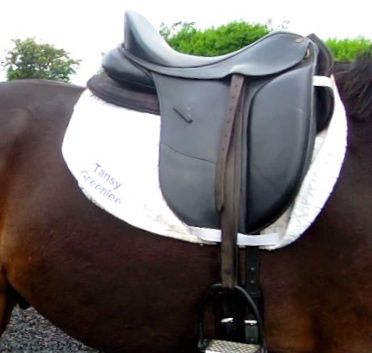
It continued to look good while lunging him – better than Flurry’s saddle looks on him, in fact, so I told my thighs and hips to brace themselves and mounted him. Hey, it didn’t hurt! Last time I rode in this saddle, my legs and pelvis felt like a wishbone that someone was trying to crack, this time it felt fine – hooray for 500km treks!
I schooled for about ten minutes, just twenty metre circles in walk and trot, asking him to bend and hoping he would engage in a conversation down the rein. He is so much better than he was last Autumn, back then he just held the bit rigid in his mouth, kept his mouth slightly open the whole time, never chewed the bit, never softened – you never felt like there was a live being at the other end of the rein, and every time I took the bridle off the bit was still pretty dry. In the past, he used to salivate quite a bit when he was ridden, which indicates acceptance of the bit and relaxation in the mouth and jaw. Now I’m feeling the odd little softening of the jaw, you can see him chewing the bit while lunging and I can feel it when I ride him, but I had yet to feel the whole “conversation” thing going on, and while the bit is a little gooey afterwards, you certainly couldn’t say he’s salivating. I think before he really relaxes, he needs to be confident that
a) I’m not going to force his head down and
b) I’m not going to jerk him in the mouth if I lose balance and fall behind the motion.
I had put a clean numnah under the saddle that day, which enabled me to see how the saddle and riser pad were sitting. I was delighted to see from the dirt marks afterwards that there was even pressure along both sides of his spine, with no gaps, which would imply that the saddle is “bridging” – sitting on two high points and missing out the piece underneath, which puts too much weight on the high points.

I had been reading up on the Micklem multibridle and thought that it might suit me, my horses and what I intend to do with them. Both Flurry and Aero like to rub their nose after being ridden, which may be because their bridles are pressing on sensitive areas. The Micklem is supposed to prevent this by being designed to avoid crossing over any points where nerves emerge from inside the skull, and also routing the noseband away from the molars, thus avoiding pressure on the inside of the cheeks where the upper teeth protrude over the lower teeth. Ok, I thought, this sounds good…. but you can lunge with it, use it as a headcoller and turn it into a bitless bridle – sounds even better, the last two being very appealing for trekking!
So what’s another €150 on the credit card? I ordered one on-line on Wednesday, and it arrived on Thursday. I hauled Aero in from the field, where he had been under the impression he was having a day off – poor boy! At least he didn’t have to work very hard – I spent a good half hour faffing about with the bridle, adjusting straps here and there and trying to get it to fit right. Having fitted the noseband as per the instructions, the bit ended up too high in his mouth. Maybe I could stretch the bit straps which connect the bit to the nosepiece… nope, it’ll take them months to soften out. I dropped the noseband a hole on each side and the bit seemed a bit better, but I wasn’t convinced about it and neither was Aero. I took him out for a little lunge and then sat up on him for two minutes afterwards, but I was getting that “dead” feel down the reins again.
On Friday I played around with it some more, dropped the noseband a couple of holes on each side so the bit looked more normal. He felt ok to ride – I’m definitely getting more used to his paces and I’m also getting better at forgetting about “poor depressed Aero” and thinking of him as any other horse who needs work. We did lots of circles, figures of eight and serpentines, just trying to get him to bend and soften a bit more through the body. Then I tried some leg-yielding, but he lost all forward motion when I asked for it in walk, so we did some in trot, too, and that felt better, at least he didn’t feel “stuck!” We did a couple of little canters then, which helped loosen out his trot a little, and we finished up with me feeling quite happy. Looking at the bridle afterwards, though, I came to the conclusion that it was fitted too far down his nose, and was possibly pressing on the ends of the nasal bones. Hmm.
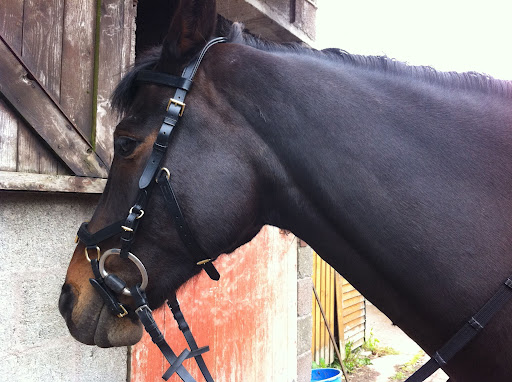
Some internet research followed, and not surprisingly, it turns out I’m not the first person to have trouble fitting a Micklem. One person who had exactly the same issues as me used two modified flash nosebands as bit straps, another person used spur straps. Spur straps! What a good idea! First thing on Saturday morning I unearthed a pair of spurs, removed their straps and got to work fitting the bridle again. I was much happier with the fit of this time, the noseband was nice and high up his nose and the bit was lying nicely with just one wrinkle in the corner of his mouth. The only problem now is that the strap which goes under his jowl is on the last hole and tight!

I tried him on the road again, but as he was still a bit tender, we came back to the arena and did a lot of work in walk. I was asking for medium walk… then free walk… then medium again. It’s something I need to work on, because I always have trouble picking up the contact after free walk. No matter what horse I’m on, he always comes above the bit as soon as I pick up the reins. I can’t say it improved in this session, but at least I worked on it! In trot, we worked on just how much of a half-halt he needs. This was interesting, if I half-halted like I do in Flurry, we got a transition, so I toned my aids down a lot, and we got a few decent half-halts. He was bending nicely on circles, yielding to the inside rein/inside leg, so much so that I was able to give and retake the inside rein and he’d maintain the inside bend. We finished with more leg-yielding, in trot first, then in walk as part of our cooling off.
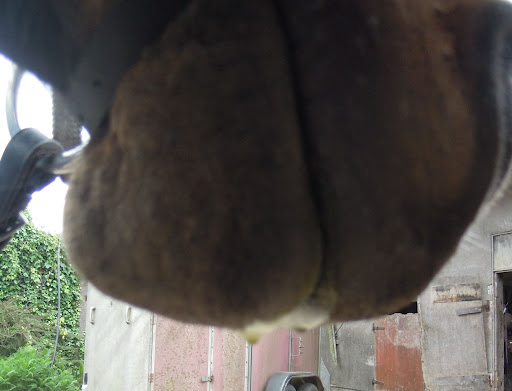
The contact felt good for the whole session – I was finally feeling like there was a conversation going on between us. Was I imagining it, or were there occasional gobs of saliva flying past me through the air from time to time? I peered down at the bit a few times, but there was no sign of “white lipstick” or even “green lipstick” from my vantage point on his back. When I dismounted, though, there it was – hanging in a couple of bubbles from his lips! Yippee!

I’m feeling brave enough to face a lesson on him now. That’ll be interesting!
Pepper

It’s strange to be able to say of a pony “I knew his father well” but I could truthfully say that about our Pepper!
Pepper’s father Glen was a 14.2, dark bay, part Connemara pony who had been gelded late, at five years of age. He ended up in the riding school where I trained for my BHSAI and lived out his days there. At first, he was lively and sparky, and only used for working pupils and experienced riders. If you were told you were riding Glen, your heart beat faster and you knew you were in for some exciting moments, especially when jumping! He settled down over the years, eventually becoming one of the stalwarts who knew exactly what to do at every point in every lesson.
A young girl who lived next door to the riding school and was a regular helper eventually became the proud owner of a handsome palomino gelding, Pepper. To my surprise, I was told he was Glen’s son, and indeed when you looked beyond the colour, you could see the same eye, the same shape to the head and a very similar physique – a little long in the back, slightly short in the legs.
I wouldn’t say I followed Pepper’s career, but I was aware of his existence over the next six or seven years. Oddly enough, I have some photos of him attending the St Stephen’s Day hunt in 1991 – we went along to follow on foot, and I took pictures of all the riding school gang as they set off.
The family who owned him left the area, but a couple of years later Pepper arrived back at the riding school – he had been sold to a young lad who was just ready for his first pony.
Well, that was a match made in hell. In recent years, I spoke to other people who had been around as youngsters at the time, and it seems Pepper had always been a little…. shall we say…. opinionated on the ground! If he didn’t want to be caught, he’d just keep moving away, and if you persisted in following him, he would charge, teeth bared and hooves flying. Once you finally managed to catch him, you couldn’t be sure of holding onto him – he had learned the art of lowering his head and tanking off wherever he wanted to go, ripping the lead rope out of your hands as he went.
He was actually very quiet to ride – once you managed to catch him and lead him back to the yard!
The boy who now owned him quickly became terrified of him, and although he kept him for a year, he regularly had to be rescued from the manger in the corner of the stable, where Pepper had him trapped.
Not knowing any of these minor details, knowing only that this twelve year old pony was quiet to ride and would jump nice and steady around a 1Metre course, when I heard he was for sale I snapped him up. The Eldest Daughter was just twelve and had been riding 12.2 ponies for a couple of years, but she had grown very quickly in the previous six months. We expected that her growth spurt would continue, so there seemed little point in buying a 13.2 for her. She was a gutsy little rider, but always seemed a little less keen than her sister, so a sensible schoolmaster, whose background I knew, seemed heaven-sent.
The first I knew of his foibles was when we brought him back to the riding school to meet up with the farrier. I unloaded him and was leading him towards the American barn, his walk got quicker and quicker… two steps of trot and then he was briskly cantering through the sliding door, past the surprised farrier, down the aisle between the stables, heading for the back door and freedom! Much to his surprise, though, I ran with him, and much to my surprise, I was able to haul him around just before he went through the back door.
He won’t try that again, everyone said. Ha! It was his party piece, he wasn’t going to give it up! In the end, we always led him either in a bridle or with the lead-rope twisted through his noseband – he never tried to bolt once he knew you’d have the upper hand.
He demonstrated his other party piece a short while later. He had jumped out of his paddock (another little trick of his) and was grazing in the front garden. Armed with head-collar and lead-rope, I went off to catch him. He watched me coming, I watched him watching me…. then his ears went flat back against his head and he charged straight at me, mouth open and front feet flying out as far they could. I think I went a little nuts, because I held my ground, side-stepped like a matador at the last minute and WALLOPED him across the neck with the head-collar. Shocked, he trotted off towards the yard – I don’t think anyone had ever stood up to him before, and indeed he never charged at me again, although he did it occasionally with other people over the years. I followed him, herded him into the arena and spent about half an hour working on join-up, until he was willing to stand while I approached and then follow me for a few steps.
That became our modus operandi. I ended up with a strand of wire ready in the paddock so that if he was difficult to catch, I could easily partition off a small section and loose school him until he was ready to give in. He quickly learned that being difficult to catch=getting extra work, whereas being easy to catch usually meant a handful of nuts, and eventually he was fairly dependable, with family members anyway.
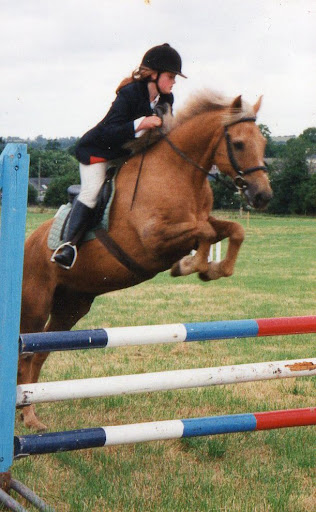 Apart from these quirks, he was a really great pony. The ED had three happy years with him and I even got to bring him along to a couple of Riding Club jumping competitions myself. Once you kept him in his comfort zone, he would jump clear rounds all day long, but once the fences went past one metre, he began to struggle. Ask him to jump a 1.20 course and the answer would be a flat “NO!” The problem with this, though, was that at the time, ponies were graded A,B,C and D. Every time a grade C or D pony jumped a double clear, it collected points, and once it had so many points, it had to move up a grade. Once they got to grade B, the courses were suddenly much bigger and much more technical – too much for Pepper.
In their first ever ABC competition, Pepper and the ED had one of those lovely “connecting” moments. The ED was walking the course – the biggest they had ever jumped, with fence heights somewhere around 1.10 – 1.15M. I was in the pocket, holding Pepper,when I realised that he was watching her every step – in fact, I think he was learning the course too! Pepper absolutely rose to the occasion, and despite the ED’s nerves, they jumped clear in the first round – it was as if he was saying “It’s ok, I know what I’m doing!” He willingly upped the pace in the jump-off, they took a couple of tight turns and literally flew around, producing the winning round. Tears in her eyes, the ED said “Mum, we are never selling this pony!” and fool that I am, that’s why he’s still with us.

He was the safe pony that you could put any visiting child up on, but at the same time he would go up a gear with a more experienced rider. He was super-safe at hunter trials – he would gallop on in the open spaces, and then collect himself up and pop the fences out of a show-jumping canter. He was just plain scarey out hunting, he would grab the bit between his teeth and go at a flat out gallop, jumping anything that came his way – banks, drains, gates… whatever.
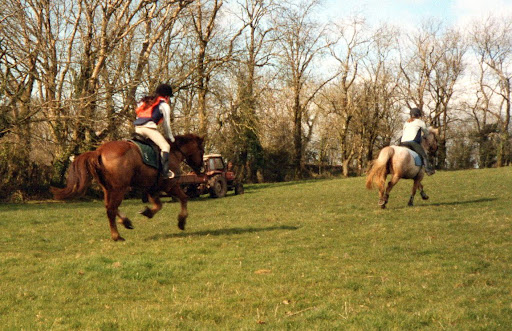
After six years with us, the ED had lost all interest in horses, the YD’s goals were higher than Pepper’s abilities and he was languishing in the field most of the time. This was when I should have sold him, he’d have been perfect for low-level Pony Clubbing, but I didn’t – I loaned him to a friend who was just starting up a riding school. After a year, my friend offered to buy him, but I refused, I felt honour-bound to remain responsible for Pepper, and see him through his vintage years. He stayed in the riding school for about five years, and was retired for the last of those, spending his days as nanny to a bunch of youngsters. The following year, though, the winter was long, hay was scarce and expensive, and my friend rang me to say he’d have to send him home.
Pepper arrived back in 2010, somewhat arthritic in his left knee and with borderline laminitis. He’s now “hangin’ in there” at the age of twenty-six. His feet have a wonderful ability to grow vigourously in a completely wrong way, so he’s always a worry at this time of year. I suspect his vision may be going, as he seems to peer at me very strangely whenever I approach him. He’s reasonably sound on good going, and is generally content with life.
He poses quite a problem for me. I need to find him a good home as an unrideable companion before I leave in October. I’m praying it works out, otherwise I will have to face the reality that if I cannot be sure he’ll be looked after in my absence, I will have to arrange a quiet end for him in our paddock. I would rather do that than take the chance that he would end his days neglected, miserable and in pain.

Saddle Stories
Aero has always been difficult to fit a saddle to. When he was jumping, we used a gel-flocked Pessoa on him, and it seemed to suit him well, we had few issues with his back in those days, but then again, the Youngest Daughter was riding in the half-seat a lot of the time. Then dressage took over, and the trouble began.
I had a lovely Albion dressage saddle, which had been a present for my fortieth birthday. We used it on Aero when he started eventing, but it became clear that it didn’t fit (it was too wide), so we had our local saddle-fitter out, and bought the basic Wintec dressage saddle that was available at the time – I can’t remember the model name. That seemed to work ok for a while, and then he started getting bald patches at the back of the saddle, and the YD started to complain of back-pain.
The saddle-fitter visited again, and we came to the conclusion that he had changed shape substantially and had muscled up particularly around his shoulders, tipping the saddle backwards. She suggested using a riser pad, but I’m afraid I have an aversion to riser pads, and I got a bit stubborn about it! My feeling was that a saddle bought for a specific horse should fit without having to be raised here, or lowered there, so we compromised and sent the saddle away to be reflocked, emphasising that it needed to come up at the back.
It made no difference whatsoever, so we scratched our heads and thought a bit. The YD was getting serious about dressage, and they were doing really well (reserve National Champions at Novice level!) so we decided to invest in their career, and buy a more expensive fitted saddle. Measurements were taken, templates were made and the whole lot were sent off to the manufacturer.
Along came the Bates Isabell Werth saddle with Cair panels and adjustable gullet – the most expensive saddle I’ve ever bought. This was the one, this would stop the YD’s back pain, put her in a better position and enable her to sit deeper in the saddle, allow Aero’s baldy patches to disappear completely, eliminate all of his tension issues and turn him into a more extravagent mover.
Yeah, right. Rider’s back pain continued, horse went exactly the same, we ended up continuing to use the big fluffy sheepskin pad under the saddle to protect his back. The saddle must be right, we said, it was fitted especially for the horse. So many riders complain of back pain that we concluded that back pain and dressage go hand in hand, and of course we had to have the horse physio out every couple of weeks, doesn’t everyone?
Fast forward to the present. I’ve been mixing Aero’s work up all week – lunging with no tack and going for a little walk in hand afterwards, or lunging with tack and riding for a short while afterwards, either in the arena or on the road. Trying to vary it and keep him interested, basically – bear in mind that this horse was depressed and arena sour when he came back to us last autumn.
I’ve always found him a little uncomfortable to ride, (I affectionately call him The Camel Horse) but I’d been hoping that after Le Big Trek, I’d be fit enough to cope with his swinging walk and big bouncy trot. Nope, apparently not. I felt like a complete beginner, falling behind the movement in trot and falling in front of the movement on downward transitions. I tried using my own Wintec dressage saddle, which, after 500km, is perfectly moulded to the shape of my bum and which feels like “home” on Flurry, but it made no difference, I still felt out of balance and awkward and Aero felt unhappy and reluctant to move forward – not surprising really, with me impersonating a sack of spuds on his back!
I had ridden in the Bates saddle a couple of times shortly after we bought it, but I found it horrifically uncomfortable – it stretched my legs and hip joints in ways they were not accustomed to, so I’m really reluctant to use it. In desperation, I tried using Aero’s old jumping saddle. He stretched nicely in walk and seemed a little happier, but I felt hopelessly unbalanced and insecure. The leather felt as slippery as polished steel under my bum compared to the nice grippy synthetic fabric of my Wintec, the flat, close-contact seat didn’t hold me the same way at all and I still felt like I was being thrown behind the movement every stride.
At rest, the Pessoa seems to sit fairly level on him but while lunging him one day, something caught my eye.
Was it just my imagination or did the saddle tilt backwards with every stride? I videoed what I was seeing and then looked at YouTube videos of horses being lunged, and I was fairly convinced that what I was seeing on Aero was unusual, so I pulled some stills out of the video for comparison.
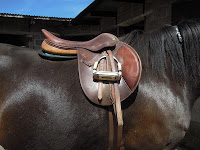 |
| At Rest |
 |
| Walking |
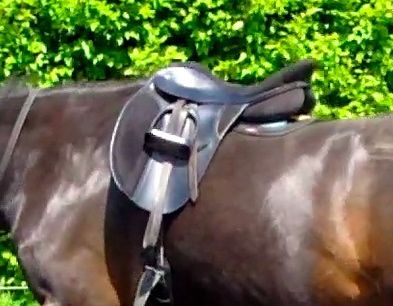 |
| In walk the saddle rocks from here… |
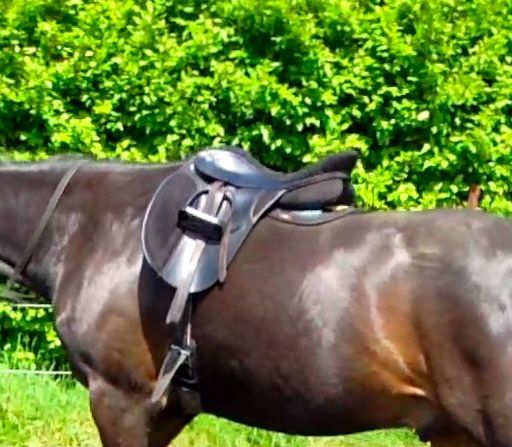 |
| …to here |
I was pleased enough with the change that I hopped up on him straight away and I was delighted to find I was better balanced, while he seemed happier and stayed rounder. I’m toying with the idea of using my gel pad as well… I’ll just keep playing around for a while til I find the best arrangement. I’m even beginning to feel like I might actually manage to ride him properly some day!
I hacked him out this morning with his Renegade boots for the first time. The boots don’t twist at all on him, unlike on Flurry and Gigi. The validates our theory that the boots were twisting because both Flurry and Gigi are not straight movers, unlike Aero.
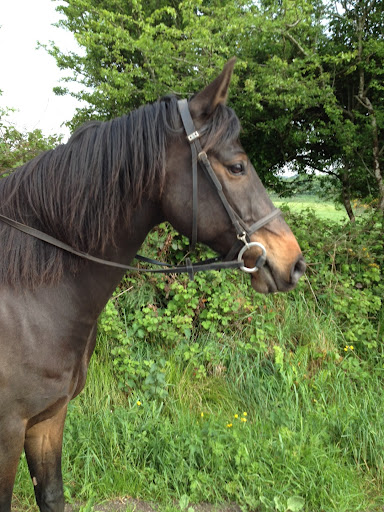 |
| Happy Aero! |
Have a look at my Art!


Commissions


 Tails From Provence