Tails From Provence
What happens when a horsemad Ould Wagon moves from Cork to Provence with 2 horses, 2 dogs and a Long Suffering Husband? Why, she gets a third dog, discovers Natural Horsemanship à la Française, starts writing short stories and then discovers a long-buried talent for art, of course…

I never thought I’d see the day…
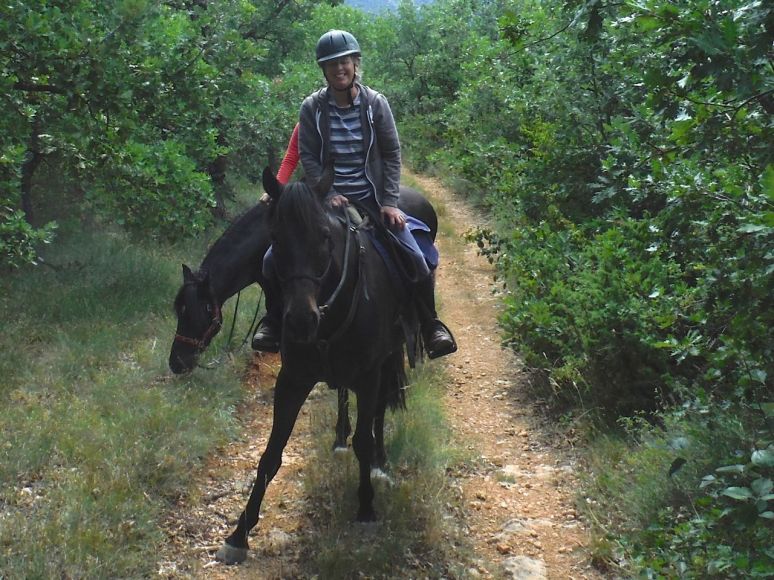
Aero, rope halter and barefoot, on a 1.5 hour ride from Reillanne back up to the horse farm. Compare and contrast with this photo from almost four years ago…

Honestly, I thought his feet would never be good enough for more than a 40 – 60 minute ride on mostly good ground. But here we are, and as you can see, the ground in the upper photo was far from good – and that wasn’t the worst part by any means!
So proud of him – and me. We’ve come a long way.
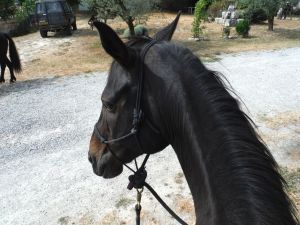
Meet the Inmates Part 2 – Harlem and Takira
After giving Flurry and Aero their hay and putting Aero’s fly mask on, my next stop is the stabled horses. There are three of them, Harlem, Takira and Rivaldo.
Harlem and Takira are brothers, in that they have the same owner. They’re two retired old boys, both in their early twenties. They’ve been at the farm the longest of all the livery horses.
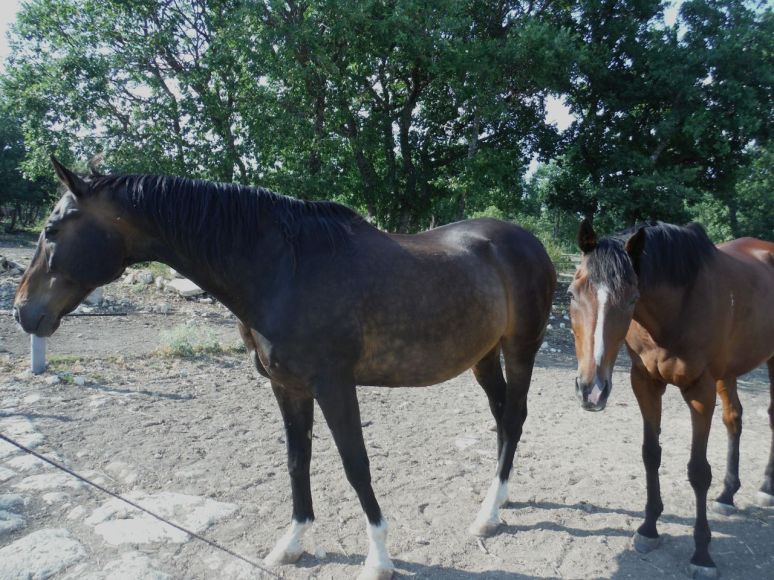
Harlem and Takira
Takira is a thoroughbred. He’s got typical TB thin skin – he hates to be brushed and, in the winter, when he’s coated in mud, it’s a terrible ordeal for him to have it brushed off. But he loves to roll…

Takira’s armour – um, I mean, winter coat!
He was still being ridden when I arrived here, but then his Girl went away to college and now he’s fully retired. He’s a nice little guy who can be a bit timid, so he gets pushed around by Harlem and Rivaldo quite a lot. Although he and Harlem have lived together for years, he quickly became best friends with Rivaldo when he arrived two years ago. He REALLY loves his carrots and whinnies every time he sees them coming! Being a skinny little TB, he can be difficult to keep weight on in winter.
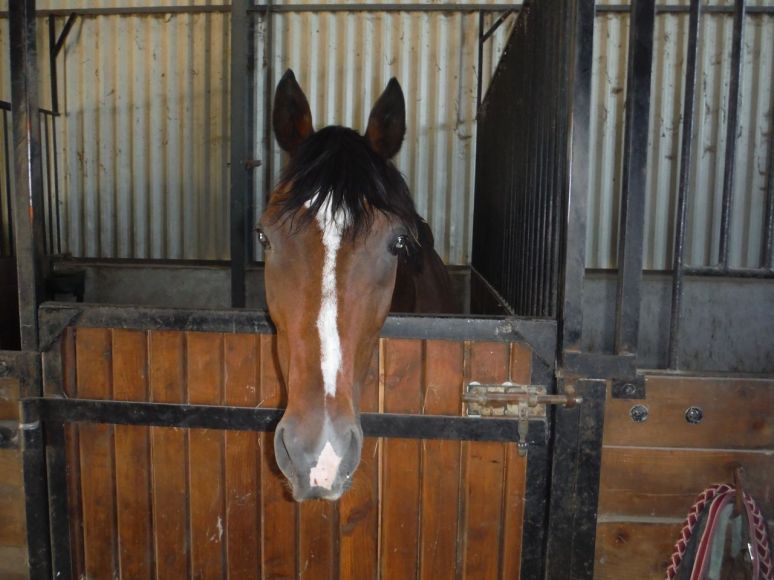
Takira waiting to be turned out
Unlike his ‘brother’, Harlem has the physique of a pregnant elephant. He’s a Selle Français and he’s a complete clown. Put his head-collar on and he starts playing with the lead rope before I’ve even done the buckle up. He’s also that One Horse who has to have a special bolt on his stable door, otherwise he opens it as soon as your back is turned. Literally. Normally, I take all three horses out together when I turn them out in the morning. I put on all their head-collars while they stand at their doors, and I take the special bolt off Harlem’s door so I’m not fiddling around with it while holding on to Takira and Rivaldo. Then I take Rivaldo and Takira out of their stables, with Harlem coming out last as he’s nearest the barn door. One morning, I foolishly opened the lower bolt on Harlem’s door, thinking that he wouldn’t have time to open the top bolt before I was ready to take him out. Nope. Five seconds later, I was at Rivaldo’s door when I heard CLIP CLOP behind me, as Harlem wandered off to inspect the bale of hay! His latest trick is closing the top bolt if I leave it open (with the bottom one latched, of course!). Funny boy!

Harlem gurning at the camera!
Rivaldo deserves a blog post all of his own, so he’ll be next.
Meet the Inmates Part 1
I mentioned a couple of posts back that I am currently gainfully employed at the horse farm where Flurry and Aero live, providing maternity cover for Alexandrine while she adjusts to Life With Julia. I thought I’d share part of my daily routine with you – that is, introduce you to some of the inmates residents at the farm.
If you’ve been reading this blog for a while, you’re already familiar with these guys. They’re my first stop when I arrive at the farm each morning.

For anyone who’s new around here, these are my two boys. The dark bay on the right is Aero and the moustachioed dun on the left is Flurry. Aero has been part of our family since the day he was born, sixteen years ago. Flurry was bought six years ago, and is now eleven years old, but can still act like a two year old when the mood takes him. They’ve been living in Provence for four years, and I can now safely say that they are finally acclimatised.
For starters, Aero has yet to wear his fly-rug this year. Every summer so far, he has been driven demented by biting flies, taons the French call them. I was able to provide him with some respite by putting a fly rug on him for the last three years, but he is clearly coping without it this year – so far. I’m not ruling it out, but I’m not going to use it if he doesn’t need it! What’s changed? Both horses have become better about seeking shade during the day (which is another sign of them being acclimatised. Our dogs have also become better about lying in the shade and not toasting themselves in the midday sun) and of course, flies are less active in the shade. I’ve also managed to find a fly spray that WORKS! It’s called Novaclac, it’s essentially just pyrethrin in a suspension, but I add neem oil to the spray bottle and also put neem oil directly on the more delicate parts of their anatomy. The neem oil helps to repel the ghastly Mouches Plates – crab flies or horse louse flies in English, Hippobosca Equina in Latin. These little fekkers fly/hop/crawl high up under the horse’s tail or between his thighs, where they cause intense irritation as they crawl around and feed by biting and ingesting the blood of their host. Stoic little Flurry is reasonably tolerant of them, but they drive Aero crazy. As soon as he feels one landing anywhere on his body, he starts to become agitated, swishing his tail, swinging his head at it or running around and kicking out violently if the fly persists. I don’t think he will ever become used to them.
Another way they’re showing how Provençal they’ve become is in their attitude to being washed. We have a major water shortage at the moment – you’ll probably hear more about this as the summer goes by – so showering the horses is prohibited. Nonetheless, they need to be sponged or brushed down with water after being ridden – they are ALWAYS sweaty. Today, I washed Aero down after a mid-morning ride, using a sponge and a watering can filled from an unused trough. Hmmm, I wondered… how would he react to being ‘watered’ with the watering can? He stood there calmly and happily was the answer. So I decided to see how Flurry would feel about being sprinkled. To my surprise, he stood just as calmly and happily while I poured water along his neck, sides and back. He was at liberty in his paddock when I did it – he could have chosen to leave any time he wanted – but he clearly enjoyed the brief cooling effect of the water. NB these are IRISH horses. They associate bath-time with unpleasant experiences involving freezing cold water and although they have always tolerated bathing, they would never stick around for it unless they were tied up.
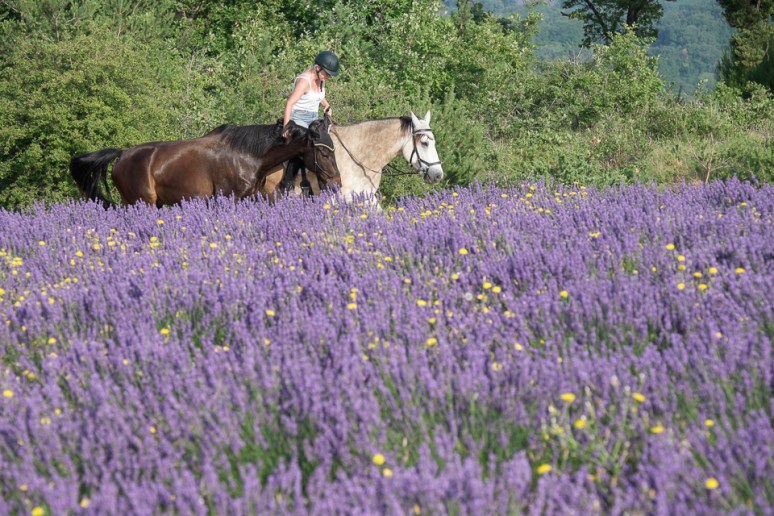
Are there any other things which show that they’ve developed a Provençal attitude? Hmm, maybe their relaxed attitude to work, play and life in general! Nobody is ever in a hurry here, few people bother getting stressed or annoyed over life’s little problems and this attitude seems to have rubbed off on my horses. Maybe it’s the calming effect of all the lavender in the air!
Have a look at my Art!


Commissions


 Tails From Provence