Tails From Provence
What happens when a horsemad Ould Wagon moves from Cork to Provence with 2 horses, 2 dogs and a Long Suffering Husband? Why, she gets a third dog, discovers Natural Horsemanship à la Française, starts writing short stories and then discovers a long-buried talent for art, of course…

Pauline Beulze clinic Part 2
Quick refresher… I had a lesson with Pauline Beulze last month. I made an attempt at working both horses on the ground at the same time, but I need to bring Flurry up to speed for that to work. If you missed it, it’s HERE. I decided to use the rest of my lesson working on ‘ride and lead.’
First of all, I retrieved Aero from where he was lurking behind the cameraman (he likes to help). Then me and Flurry hauled him off to the centre of the arena and stopped. Pauline very politely said yes, that’s all very well but if you want to work with Aero at liberty eventually, you can’t drag him around – you must get him to move by tapping him on the back with the stick.
Off we went again, in walk and then trot. That all seemed to go ok, so we tried a little bit of backwards. The first time was okay-ish, the second time, which is in the video, wasn’t bad at all.
So, forwards in walk and trot was fine. We discussed cantering, and I’m sure it will happen in the not-too-distant future. We also discussed whether it’s better for Aero to stick one particular side (of Flurry). Pauline’s feeling was that, with just two horses, it doesn’t really matter and it’s probably better to have him working off either side, although if you have four or five horses working together, each one has his own place in the line. Interesting.
Next we tried sideways, which I have made one or two feeble and unsuccessful attempts at before. Going to the left, with Aero following, was ok on the second try, although I felt Aero’s hindquarters were trailing. But at least we all went sideways for a few steps. Going to the right was a different ball-game, poor Aero struggled to figure out what I wanted. On the third attempt, Flurry basically went “Oh, for feck’s sake, Aero!” and pushed him in the correct direction. So yeah, it worked, and we now have something to improve on.
Believe it or not, that was thirty minutes of lesson. I’ve edited it down to just over eight minutes. I left the audio as it was; French speakers will probably get a lot from what Pauline is saying to me, but you’ll need to turn your sound WAY up. Also, apologies for loud quad-bike noises at six minutes!
PS this was my first time using Youtube’s video editor. I’m not thrilled with the result, it seems a bit choppy, but I think I will do a better job next time. Which will be the final part of the Pauline lesson, working Aero at liberty from Flurry’s back.
I digress for Rugby. Again.
The Rugby World Cup continues to eat into my spare time. (For those of you who missed it, I blogged here about my trip to Cardiff to watch Ireland trounce Canada a couple of weeks ago.) Ireland were truly blessed with a comparatively easy pool – we were almost certain to emerge in the top two at the end of the qualifying rounds, thereby earning a place in the quarter finals, but the biggest threat in our group was France. And where do I live? Yup, France!
However, I live in a part of France where rugby is not big news – they generally prefer Le Foot around here. Despite this, we’ve found one or two rugby loving friends – the LSH especially – while many of our other friends tolerate our passion with a sort of bewildered affection.
The final game in Ireland’s pool was against France. It would decide who won the group and, with that victory, the slightly less difficult route toward the semi-finals – meeting Argentina in the quarter-finals as opposed to meeting the All Blacks. Yesterday was The Big Day.
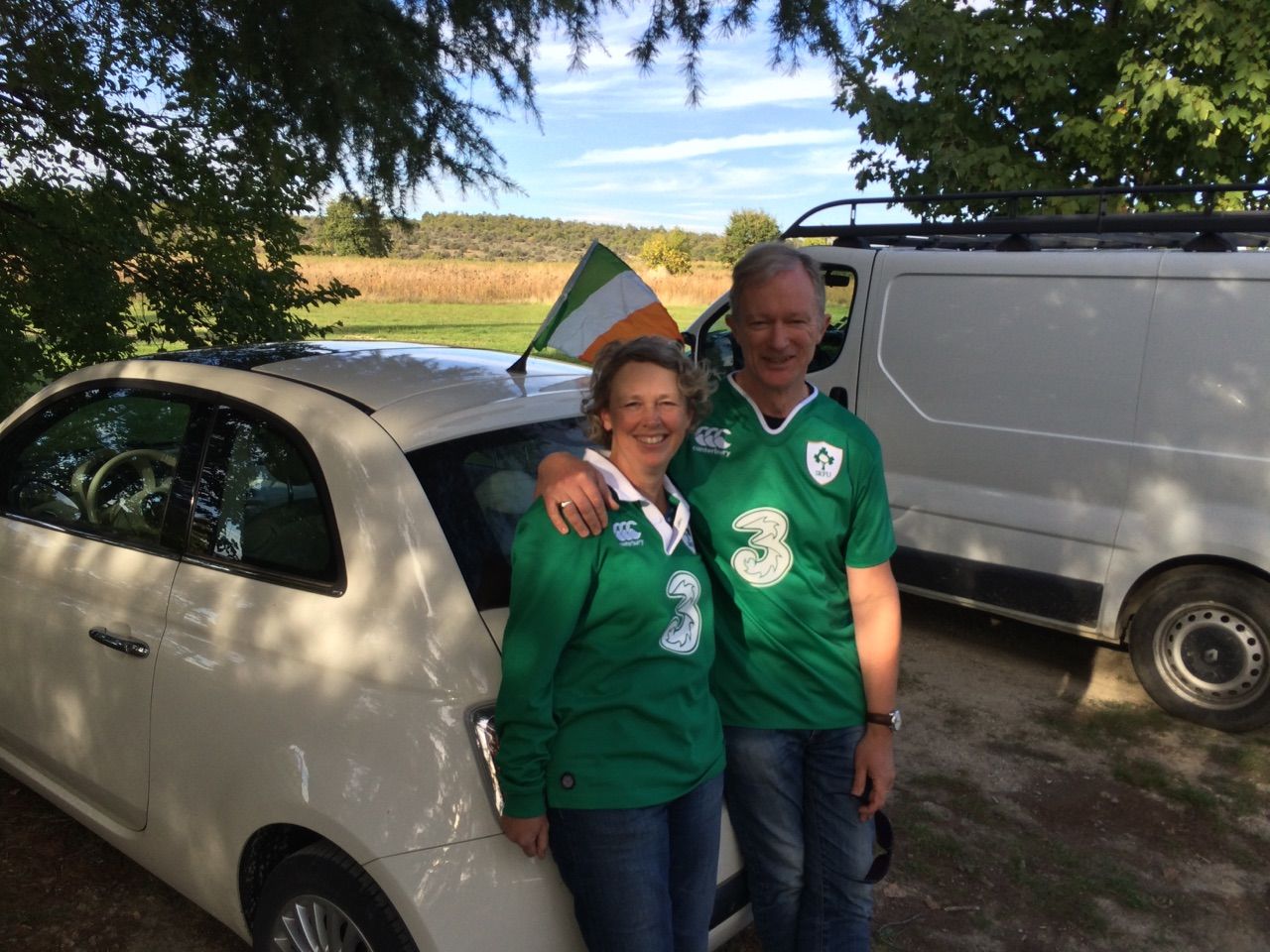
We went all out for team and country. We dropped down to our local coffee shop first thing, resplendent in our green jerseys, to tease the proprietor and to give him an Irish flag. Later on, I was meeting MC to go for a ride and I wore my Ireland jersey (although it was bloody hot by then), stuck cardboard flags onto the sides of my jeep and hung another flag out the window. MC is one of the friends who falls into the ‘bewildered affection’ category. She cracked up when she saw what I’d done. Well, that was more or less the intention. I then threatened to drive her through the market. Non, non, she said she would hide in the footwell if I did. I relented, we went for our ride and then I whizzed home to shower and change.

We had been invited to watch the game with Eric, one of the LSH’s rugby-loving friends, in his village. The whole village would be there, he said. We would be adding some exotic colour (mostly green) to the affair 😉
We had no idea what to expect. Would it be outdoors? It’s a bit cold in the evenings for anything outdoors now, so maybe not. Eric then said it was in a sort of private club. And we could play petanque beforehand if we liked.
Not knowing what to expect, we donned our green jerseys and set off. I wanted decorate the Fiat 500, but I couldn’t find the shamrock chains I had made for St Patrick’s day. We brought some little cardboard flags and two ‘proper’ flags instead.

Shamrock chains would have been so good…
The private club turned out to be Eric’s cave, which he has turned into a village open house. Brilliant idea – the village is tiny, with no facilities at all, and Le Cercle de St Pierre give them a place to hang out, have a few beers and chat.
They had dug out a few flags too. And a trumpet. And Eric had a commemorative t-shirt from the All-Blacks/France game in Marseilles in 2009. Very cool.
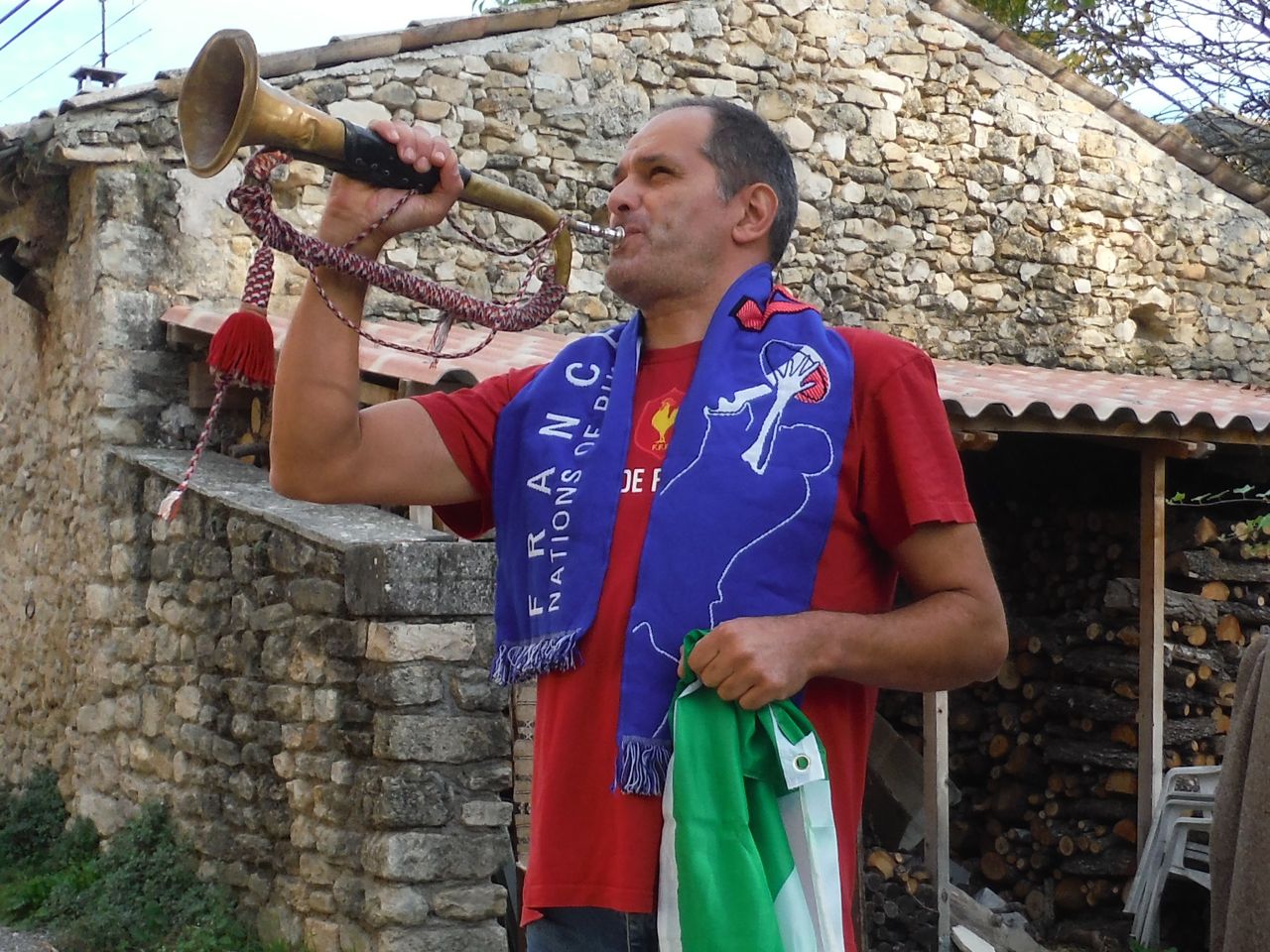
We went and played petanque for about half an hour. I had never played it before and I was quite worried that I might brain someone with one of those heavy metal balls. Yes, my throwing skills are THAT bad. Thankfully, I didn’t kill any of our hosts and, miraculously, my team (Eric and I) won. The first victory of the day went to a combined Irish-French team – it was only fitting, really.
One of the things I love about rugby is that all the fans get on so well.
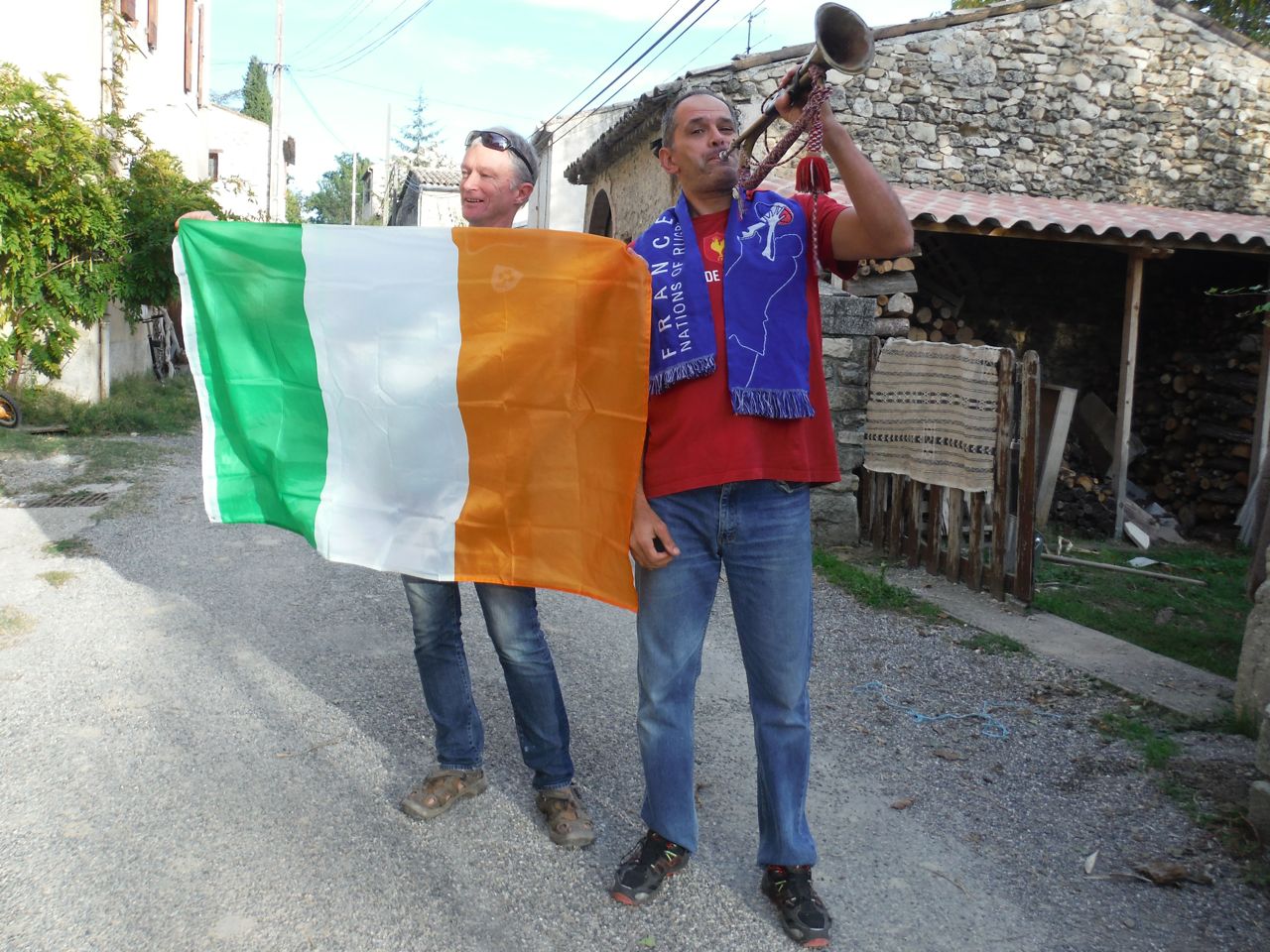
Whatever their ages.
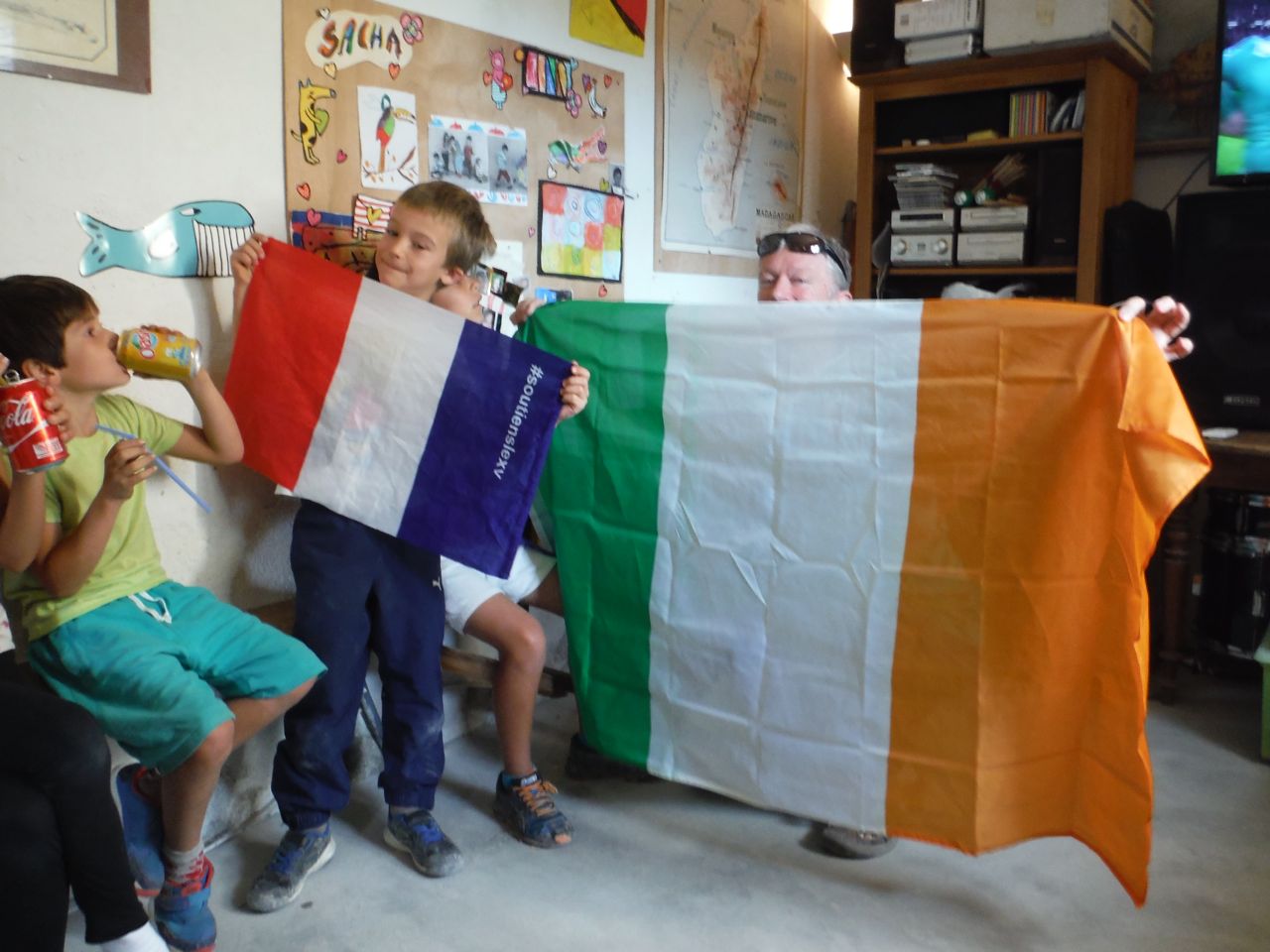
The villagers of St Pierre were no exception. One and all, they greeted us warmly. Many of them spoke excellent English, and relished an opportunity to practise. We helped ourselves to drinks from the fridge and everyone settled down to watch the game. Cake and saucisson were passed around and I immediately regretted not bringing the round of Clonakilty black pudding that’s sitting in our freezer. Next time…
Good moves on both sides were met with appreciative gasps and claps. Everyone in the room greeted the early departure of two of the top Irish players with genuine regret. Sexton and O’Connell going off injured should have been a devastating blow to the Irish team, but it wasn’t. Instead, the Irish seemed to become stronger and stronger. As each Irish substitute player was brought on, the French hoped for a lessening in ferocity, but they were disappointed; the opposite seemed to happen. The Irish players were, to a man, immense in every sense of the word.
At the end of the game, Ireland were clear winners with a score of 24 against France’s 9. Our hosts were gracious in defeat, but I’m sorry to say we weren’t gracious in victory. We set off for home waving the flag out the window of the Fiat 500 and tooting the horn as we drove down the narrow street.
It’s possible that Ireland and France could meet again in the finals. Wouldn’t that be fun.
I really must find those shamrock chains.
Pauline Beulze clinic Part 1
Finally! A follow up to my Four Legs Good, Eight Legs Bad post! It’s been hard work editing the hour-long video, but I’m getting there.
So the start of my lesson was less than stellar, as you could see in the first video.
Pauline very quickly came to the conclusion that I have one horse much more advanced than the other. (Aero being more advanced than Flurry, in case you missed that.) She’s right, but the previous time I worked them together, only a few days beforehand, they had been superb. But you have to work with the horse (or horses) that you have on any given day, not reminisce about the horses you had a few days ago. Sigh.
I had to quickly make a decision. How could I get the most out of my lesson? Improving Flurry’s groundwork is something I can do on my own and with help from Alexandrine. Working more than one horse at a time is something that Pauline does a lot of, both ridden and from the ground, and it’s something I enjoy playing with. Decision made – I would ride/lead and see how what pointers Pauline could give me. But first, I needed to warm up and ‘connect’ with Flurry. Shouldn’t take long, I thought…
We got away with nothing. I mounted; I gave him his piece of carrot for standing quietly as I hauled myself onto his back; he meandered off. “Non, non,” she said. “Recule! (back up).”
The horse must stand still until I ask him to move, she said. It must always be my decision, not his. I’m sure I’ve heard this before once or twice, and not in an Natural Horsemanship clinic! If he starts to move before being asked, I should back him up, halt again and ask him to walk on after a moment. But because we are always thinking of lightness, I’m not ever allowed to pull him backwards, I lift my hands, taking a gentle feel on the halter and, if he ignores that cue, I tap the front of his chest with my schooling whip – the is the same as my reinforced ‘back up’ signal on the ground.
Once she’d spotted that particular weakness, we started working on walk/halt and trot/halt transitions (which a lot of the day’s students had to work on). Pauline’s approach to a poorly executed transition is the same as her approach to a poorly executed halt, you ask the horse to back up, stand for a moment and then move forward and repeat the exercise. From my dressage training perspective, the backing up transfers the horse’s weight to his hocks, making him light in front and making the transition easier for him – so long as you do it within a short time. So, yeah, it works. Remember to give loads of praise when he does it well, instant correction when he does it poorly! Consistency!
As soon as I went into trot, she picked me up on contact straight away. I had started my normal contact, with a feel on the halter, asking Flurry to come into an outline. No, no, forget all that – with an insensitive horse like Flurry, who likes to lean, I need to have very little contact if I want to make him more responsive. Okaaaay… think washing lines for reins. The BHS instructor in me was horrified, but I went for it as best I could anyway. And he did indeed seem to lighten up by the end of our twenty minute warm-up.
Here’s a short video of the ridden work with Flurry alone.
I’m working on editing the ride-and-lead work, that’ll be the next blog post.
Have a look at my Art!


Commissions


 Tails From Provence