Tails From Provence
What happens when a horsemad Ould Wagon moves from Cork to Provence with 2 horses, 2 dogs and a Long Suffering Husband? Why, she gets a third dog, discovers Natural Horsemanship à la Française, starts writing short stories and then discovers a long-buried talent for art, of course…

We’re growing pot

Oops, sorry, we’re growing pots plural.

Wait, no, that’s not right either. We’re actually growing potatoes.
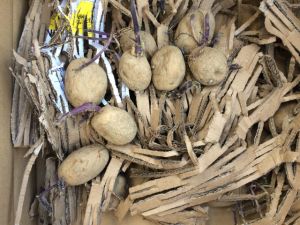
The pots are the irrigation system, as per that book I mentioned, Gardening with Less Water.
The idea is that you seal the hole on the bottom of the terracotta pots, then you bury the pots almost up to the rim. You fill them up with water, which then seeps through the porous pot into the surrounding soil. It’s an osmotic process, so apparently the rate at which water goes through is proportional to the rate at which the surrounding roots soak it up. Not convinced. We will see.
We’ve planted four seed potatoes around each pot and have left the side nearest the walkway unplanted, for ease of pot-filling. There’s also plenty of room to make a small trench on each side as we dig into the soil for earthing up the potatoes. That’s why these pots aren’t fully interred, by the way – to allow for the fact that we’ll be covering up the potato shoots for the first couple of weeks.
I was lucky enough to pick up 20 second-hand terracotta pots and their saucers cheap on leboncoin (a French version of donedeal or craigslist). These are phase one of our terracotta watering system. Phase two is these guys :

These are ollas, based on a clay pot used by the Chinese for irrigation more than 2000 years ago. I managed to find these on ebay, in France, mind you. At least they didn’t have to come from China! But the price! Per pot, they were roughly ten times what I paid for the plant pots. I have a suspicion it will be a matter of ‘You get what you pay for.’ Water seems to go through the plant pots incredibly slowly. So slowly, in fact, that I fear there is some sort of impermeable layer in them. Whereas the olla we tested became wet on the outside within an hour of being filled with water.
Hmmmm. Worst case, we will have to water our spuds the conventional way. Even worster case – everyone tells me that potato growing is a disaster here, so I could spend the summer watering with nothing to show for it.
Oh well, it’s all experimentation.
Next in series : Growing Water Bottles
Pervious in series : Gardening with less water
Aero’s Airways
This time last year, I had a coughing horse.

More Woe than Go, 18/04/2018
This time two years ago, I had a coughing horse.

How I almost entered an Interdressage test 04/30/16
This time three years ago, I had a coughing horse.

A riddle, wrapped in a mystery, inside an enigma 02/14/15
Last year, we treated Aero with cortisone injections throughout the allergy season. I also took to soaking his hay, all the time. This meant that hay for all three horses needed to be soaked, which was indeed a pain in the butt, but it definitely kept the cough at bay. After discussing my options with the vet, I decided to investigate immunotherapy. A blood sample was taken, and sent off. The results looked like this :


In a translated nutshell, he’s mildly allergic to the following aerborne allergens :
timothy, ryegrass, scutch, oat and rye pollen
flour mites, mould mites and grain mites
and the following alimentary allergens :
soya, carrot, sugar beet, rye, oats and lucerne
with scutch pollen being the only one in the “red zone.” At 402, it’s still not a high positive result – over 1000 is considered high. I’d hate to see a horse in that zone!!
It’s interesting that they are all things he’s been exposed to all his life… I fully expected oak and cedar pollen to be a problem, but they’re not! So there goes the “He’s got breathing problems because I moved him to Provence” guilt trip.
The plan was to start treatment just before pollen season started. I called the vet, who ordered the magic potion. Then we arranged a shady-looking meet-up in a car park to hand over the box containing said magic potion.

The following day (March 14th), I gave Aero his first injection, followed by a second one a week later. He had his third one on the 21st of April and I will continue to give him monthly injections for a total of ten months.
I was very careful not to imagine that I was seeing an improvement. After all, with soaked hay and during a cold, damp (for here) winter, his cough had been non-existent for several months. However, he always had a slightly runny nose. Was it wishful thinking when I felt this had dried up within days of the second injection? I kept quiet and waited for pollen season to hit.
We’re now slap bang in the middle of Provençal Spring (the very best time of year here IMO).
 Trees, flowers and grasses are exploding into life, colour and pollen.
 And my allergic horse is still cough free! Woohoo!!
I’ve had him in the dusty arena a couple of times – no coughing.
Out on the trail – no coughing.
Turned out into the grass paddock yesterday for the first time, with lots and lots of galloping around – not so much as a little clearing of the throat.
I’m now 100% confident that the immunotherapy is working. I will continue to soak his hay, keep his shelter as dust free as possible and not expose him to the dusty arena too much, but I am very, very happy that’s he so well.
Mind you, there are other little reminders that he’s getting old. His two hind fetlocks are puffy in the mornings, and boy has he lost his topline 😦
We may beat the cough, but we can’t beat time.

PS. Adding this to say that I’m just back from a ride on Aero. No coughing, but a slightly runny nose when we had finished. Fingers crossed that when all the grass pollens hit he’ll be able to cope.
Gardening with Less Water
My father was a keen gardener. When we lived in Shannon, in an estate house with a standard small garden, he grew flowers in his garden and vegetables in an allotment just outside the town. I have many childhood memories of weeding and petal-picking, which I hated. More interesting jobs like actually planting things, squishing pests and pruning were reserved for adult hands.
I wasn’t a fan of the allotment, to be honest. I was notoriously bad at eating my veggies as a child – to this day I still detest many green leafy vegetables. Brussels sprouts? Cabbage? Bleuchhh. So while I liked the pretty flowers in the garden, the whole idea of growing vegetables seemed a bit pointless to me.
Fast forward thirty years or so, and I was slightly better at eating my greens (I still can’t handle sprouts and cabbage, though). I was also beginning to be concerned about the amount of chemicals in the food we were eating. Organic produce was outrageously expensive, so with the help of a friend, I started to cultivate the very old, very mature manure heap beside our arena in Cork. This stuff was amazing! It was like digging into a bag of the most expensive compost money could buy! And we grew the most fantastic gigantic vegetables that first year, in a very small space. The following year, we tackled the rest of the manure heap, digging out the nettles and scutch, and replacing them with beans, onions and other stuff.


The results were so successful that, over the following winter, we installed four raised beds at the back of my house and filled them with the black gold from our muck heap. Our growing space was more then quadrupled, and we successfully cultivated strawberries, broccoli, curly Kale, courgettes and other squashes, peas, beans… and more. Enough for two small households for the whole summer. All delicious, all organic.


And then I moved to France. The manure heap became a wilderness once again, as did the raised beds.


I grew a couple of things in the garden in Cereste, where we spent almost three years, but I didn’t want to make any great changes there, seeing as we were just renting. We moved into our own house two years ago, too late in the season to plant, but last year we put in a small potager. We planted onions, herbs, rhubarb, tomatoes, cucumbers and peppers, with mixed success to be honest. I’m not used to growing things in a hot, dry climate and I was appalled at how much water our little garden consumed. Particularly seeing as we were in a serious drought for most of last summer.


Despite the lack of stellar results, we’ve doubled our growing space this year. A couple of months ago, I began to research irrigation methods, the idea being that we’d install the irrigation system as we laid out the new beds. We’ve got two 1000 litre tanks for rainwater. The idea was to get a third tank, install it beside the garden, fed from the rainwater tanks, and run a standard drip irrigation system off it – goutte à goutte or drop by drop as the French call it. The problem was, losses by evaporation are huge using this method. Our water consumption would far exceed 3000 litres over the course of the summer. Sure, I’ll be able to fill up a tank on the back of the Canyonero from the village fountain (fed by a spring, it has never run dry, even last year, the driest year ever here) but even so, maybe there were other irrigation methods? I turned to Google…

…and I found this book.
Low cost? Sounds good. Low tech? Sounds even better. Use up to 90% less water? Really? Could that be possible?
And our adventures with alternative irrigation systems begins.
Next in series : We’re Growing Pot
Have a look at my Art!


Commissions


 Tails From Provence