Tails From Provence
What happens when a horsemad Ould Wagon moves from Cork to Provence with 2 horses, 2 dogs and a Long Suffering Husband? Why, she gets a third dog, discovers Natural Horsemanship à la Française, starts writing short stories and then discovers a long-buried talent for art, of course…

The Woman who Reads Pony Books for a Living
(and boy, am I jealous)
I’d never thought of horse and pony books as a recognised fiction genre, but yes, they are indeed. Am I the only person to whom this is a surprise?
When I volunteered to review Dream of Fair Horses, the name Jane Badger trotted lightly past me in a couple of emails – Dream of Fair Horses, in its electronic incarnation, seemed to be coming from a company called Jane Badger Books. Who or what was Jane Badger Books, I wondered (as well as, What a cool name!) What did this person have to do with re-issuing Patricia Leitch’s old favourites? Was she a relative of Leitch? I ruled out this idea straight away, as her website also mentioned a re-issue of Josephine Pullein-Thompson’s books in the near future. But what was her background? How did she get into this niche market? Her website and her blog are devoid of personal information, making me even more curious about her. Knowing that at least ONE reader will be interested in her story (hi meidhbhe!), I asked her PR agent if I could interview her. A date and time were set, a WhatsApp call was made…

Jane Badger, Champion of the Pony Book
It turns out, Jane Badger is probably the world’s foremost authority in the world of classic pony books. Titles, authors, character names and horse names rolled easily off her tongue during the course of our conversation, sparking many vivid memories in my mind. If she was on Mastermind, her specialist subject would no doubt be “The works of the Pullein-Thompson sisters.” But how did she get to where she is today?
Like me, and like a great many of my followers, Jane was a horse-mad, horse-less child. We read the same books and magazines; we played with the same plastic horses; and we lusted after the same Julep models that were priced way way out of our league. Jane never did get that horse she dreamed of, but she has made herself a cornerstone of the horse world, through her extensive knowledge of equestrian literature, and through her ambition to bring some of her old favourites back into the public domain.
It started off unintentionally. While on a family holiday, Jane spotted a hardback version of a book she’d read as a child in a second hand shop. She didn’t buy it, but regretted her decision almost immediately and returned to the shop. Alas, it was gone, but she saw another old favourite and snapped it up. That was to be the first of many! She soon built up quite a collection, but then realised that there is actually a big demand for these old, out of print horsey books – especially the first editions. She started buying and selling on e-bay and quickly became one of the biggest dealers in the genre. But if you look at her website, you will see that Jane is also the driving force behind re-issuing many of these out-of-print favourites as e-books. How did this come about?
With a somewhat sheepish smile, Jane told me that she got the idea of buying an out of print book that had been a favourite of her late father as a gift for her godfather. Unfortunately, her godfather’s eyesight was no longer what it had been and the typeface in the book was very small. She had the brainwave of scanning the book into a PDF file, thinking that the PDF file could be read on a Kindle with a large font size. Then she had a eureka moment – she could import the PDF into Word, and then export it as a Kindle file. Et voilà – her godfather could read his book! But, more importantly, this was an easy way of re-publishing some old favourites! Sure, proof-reading is essential, but the system is quick and painless. She started contacting some of her favourite authors (or their estates) and now has permission to re-release a number of books, and has plenty of others in the pipeline.
Who is buying these books? It probably is predominantly old dears like ourselves, for whom these books are a transport back to a more innocent time, where you could spend the afternoon sprawled across your bed with your nose in a book, and not feel guilty about all those things you should be doing instead of reading. However, Jane feels that there is a steady demand from younger readers as well, for whom these books can be a form of fantasy fiction. After all, if children are reading about training dragons and slaying vampires, why shouldn’t they enjoy reading about an idyllic summer spent with ponies in a world that existed fifty years ago?
We discussed the complete lack of boy-girl relationships that’s apparent in all British classic pony books. I have a clear memory of all relationships being more or less equal and asexual in the books I read. This is in stark contrast to the later Saddle Club books, where the protagonists could become boyfriends and girlfriends, and indeed compared to the modern-day Defining Gravity series which I have just read (gonna talk about that in a later post!). Was this to do with society at the time? Probably, but it was a decision that was made by the publishers. In Josephine Pullein-Thompson’s series about Noel and Henry, in the last book of the series, there’s a hint that Noel and Henry kiss (Noel is a girl, by the way. I think a homosexual relationship would most definitely have been a bridge too far in the 80s!). Well, it turns out that her publishers, Collins, didn’t want any more of the series after that. You can see their argument – it was a series about children, and now they’re young adults? How did that happen? The Famous Five never had to grow up! But thousands of readers have been left hanging, wondering what happened with these much-loved characters. Wonder no more – Jane met Josephine, and tells us what she had planned :
Their fate was never committed to print, but Josephine envisaged Henry going off with a dressage rider, but coming back to Noel (who presumably did not judge him too harshly for his defection.)
As well as no romance, there is little evidence of the signs of stress we see in teenagers today. Eating disorders are not discussed, although the skinny girl who eats an apple a day could be a typical background character. The only form of self-harm I remember is a quote along the lines of “I like hunting because it’s nice when I stop!” – so yeah, self-harm was unknown back then, or certainly unacknowledged. There’s no drinking or smoking mentioned in pony books, either, although I’m pretty sure my home town wasn’t the only place where teenagers stole from their parents’ drink cabinets! No mention of drugs seems fair enough; in the 60s and 70s the only drugs I knew about were alcohol and tobacco…
Other issues which are relevant to all teenagers do come up, though. The bullying, pushy parent; the spoiled, selfish child; the person who has it all, yet is jealous of anyone else’s success. How hard work will not always win you the prizes you dream of; how to face and accept the loss of loved ones. So, they are certainly not to be dismissed as pulp fiction for kids! And I shall no longer feel guilty about still reading pony books into my adult years!
What can we look forward to to fill up our Kindles?
Check out Jane’s website to see! Jane Badger Books
And explore Jane’s old blog for lots of interesting articles about this genre that we love so much! booksandmud.blogspot.com
 Best of all, not only is Jane an expert on the world of equestrian literature, she’s also published a book on the subject, which is about to be reissued in Kindle format! It’ll be available from June 20th, and you can read all about it here.
I’m off to pre-order mine…
PS. Some of the random titles that came up during the course of our conversation :
Tan and Tarmac although I was actually thinking about Jump to the Stars (Bobby and Guy, remember?), by Gillian Baxter
No Mistaking Corker, Monica Edwards. And as a consequence, I remembered Cargo of Horses by the same author afterwards. What an adventure story!
The Jill Books, Ruby Ferguson. Sadly, these will most likely not be issued as e-books. Jane has not yet managed to track down who owns the rights to this much-loved series.
The Showring Series, Caroline Akril. I’d never heard of these, but they’re already there on Amazon, waiting for me! How did I miss these?
The Silver Brumby, Elyne Mitchell. I was Thowra for so many years…
Flambards, KM Peyton. Thanks to Samantha Hobden of Haynet, I finally got to watch all of the TV series a couple of years ago!
Do any of these ring a bell with you? Join me for a hack down memory lane if you can!
Equestrian Reads Review – Dream of Fair Horses, Patricia Leitch
When I was a child, most of my book-reading was done courtesy of our local library. Unfortunately, they never had a great selection of pony books in the junior section… they had all of the Swallows and Amazons books, Enid Blyton’s series etc, but apart from Black Beauty, very little for a horse mad girl. As a result, I was limited in my access to pony books as a child. Pocket money and birthday money was spent on pony books, of course, but somehow I never really got into Patricia Leitch, although I did have A Pony of Our Own and Jacky Jumps to the Top. Patricia’s much-loved series about Jinny and her Arabian mare Shantih passed me by when I was the “right” age for them; perhaps I was already hooked on the Pullein-Thompson sisters and was saving my pennies for their works. I did read a couple of the Jinny books later on, when I was in Uni I think, and I enjoyed them but did not devour them as I would have ten years earlier. But when Samantha Hobden of Haynet put out a call for book review volunteers for a couple of Patricia Leitch books, her name rang a major bell in my head and I jumped at the chance.
I had a choice of Dream of Fair Horses or the Horse From Black Loch and I opted for Dream of Fair Horses. Being Irish, I thought it was to do with buying an amazing horse at a horse fair. How wrong was I? I soon found out when I read the blurb on Amazon!
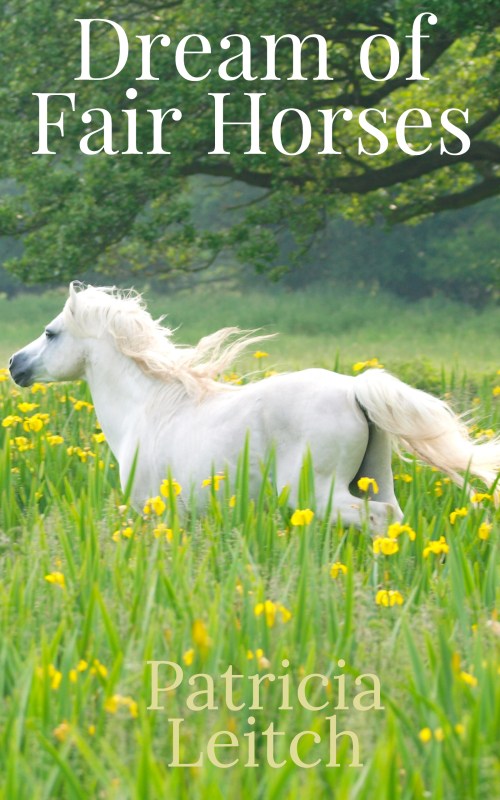
‘In all my life, I had never seen anything as beautiful as this grey pony … ‘
Gill Caridia and her family are on the move. Gill’s father writes the sort of book that literary papers love, but which few people actually buy. And then he writes a detective story that sells so well he buys back the house in the countryside where he grew up. It means change for all the children, but for Gill it means the chance to find horses, and not just horses but to ride at Wembley. But Gill learns that no dream comes without cost. This passionate and vivid story, which takes Gill from the age of 11 to 13, looks at what it really means to own something.
I downloaded my copy and got stuck in. Straight away, I noticed something that I’d also noticed on a recent re-read of My Friend Flicka. There’s a whole lot of grown-up stuff going on behind the horse-mad kid story that I had missed as a youngster – Ken’s mother’s sadness in Flicka, for example. In the case of Dream of Fair Horses, what struck me was how dysfunctional Gill’s family was. Would I have spotted that as a teenager? I’m not sure. Maybe I would have just thought that they were cool and quirky.
There is the father, who lives in his own world of literary art and interfaces badly with the real world. Doubtlessly he loves his children, but he is ill-equipped to raise a family. This is more than hinted at in the first two paragraphs : “We were going to put down roots, we had tinkled on tin feet for too long” and “when Marc was one we moved to Hallows Noon and we lived there for nearly two years which is a record for our family. Until Hallows Noon, we had never stayed anywhere for more than a year.”
The mother is the practical one, who tries to hold everything together, feeding and clothing her family from practically nothing. The eldest brother, Ninian, “struggling to be himself” is actually trapped in the rôle of father figure. He reuibuilds and repairs their home, gives Gill sage and timely advice throughout the book, and supports his siblings in their dreams, all the while dreaming of University for himself. The next brother, Torquil, escapes his family life by becoming “lost in a world of bugs” while the next in line, Francesca, dreams of being a singer but is “cursed with tone deafness” – yet she makes friends easily through her willingness to go on stage and perform. The two younger girls are extras to the story but they maintain the theme of children struggling to cope. One has learned to be self-sufficient and to integrate herself into each new community she faces by joining Brownies or whatever club is available and the other is easily bullied by her peers and struggles in school. The last child, Marcus the baby, “merely existed” but is in fact the reason for the move which starts this story.
So on the surface, we have the classic tale, “pony-mad, pony-less girl meets pony, girl falls in love with pony, girl gets to ride pony and wins big competition” as the main story line and, behind it, we have the story of a family under pressure.
The horse and riding knowledge in the book is impeccable; the interpersonal relationships are well-crafted.
Gill’s slow-growing friendship with the disfigured old man who owns the beautiful grey pony is utterly believable yet, again, things are hinted at. How did his son die? What caused the scars on his face? Leitch clearly had a back-story in her head for this character, and for his unpleasant daughter-in-law.
Although Gill’s father has occasional fatherly moments – when he catches Gill alone in the middle of a lake in a leaky old rowboat, for example! one wonders will he ever face his responsibilities as a parent, or will he remain lost in his world of words forever.
The eldest brother continues in his role as father-figure throughout the story in a way that left me pitying him for missing out on his childhood, but respecting him as a person. His words to Gill after a very disappointing first visit to the local riding school really struck me. It’s not up to you to judge. If you don’t like it, leave it. Get what you want. Don’t go around trying to change other people. They don’t want to be changed. They are really enjoying themselves and the sooner you learn this, the easier life’ll be for you. You’ve got to get what you want and let them get on with it.
Gill takes her brother’s advice and does indeed get what she wants through a process of luck (being in the right place at the right time), pluck and dedication. But, as the pony story unfolds in its predictable way, you are aware of her family disintegrating in the background, leaving Gill facing a difficult choice towards the end of the book.
I’m not going to give away any more. Suffice to say, this is not a pink, fluffy, rainbows and butterflies ponies book; this is a very real tale of someone putting in all the hard graft and succeeding against the odds. But winning isn’t everything – life goes on after the trophy has been proudly placed in the cabinet…
Would I recommend this book? 100%. No matter what age you are, if you’ve the slightest interest in horses, I think you’ll enjoy it.
I zipped back onto Amazon once I’d finished Dream of Fair Horses and bought The Horse from Black Loch, also by Patricia Leitch. I haven’t managed to read it yet – I got side tracked by another series which Amazon offered me. I think you can expect a few more Equestrian Reads Review soon.
PS For more horsey reads, check out Jane Badger’s website. She’s currently resuscitating many classic horse and pony favourites. Haynet Blog wrote a piece about her plans here
You’ll find Dream of Fair Horses and The Horse From Black Loch if you search on Amazon.com. Hopefully there will be more old favourites following soon.
10 Day Challenge
I’ve been challenged.
Ten-day horse family challenge. Every day, select an image from a day in the life of owning, loving, driving and riding that has had an impact on you and post it without a single explanation and nominate somebody to take the challenge. That’s 10 days, 10 horse photos, 10 nominations, and 0 explanations.
Like my challenger, I bent the rules somewhat. 1 day, 10 photos, 0 nominations and 9 explanations.
I decided to go waaaaay back in time to pictures that haven’t seen the light of day in a long time.
ONE
Oldest known photo of me on a horse. She was a bay TB mare at the riding school called Artic Witch. I liked her a lot. In front of me was my super-cool friend whose dad owned the riding school. She’s on a pony called Silver. I guess we were about thirteen at the time.
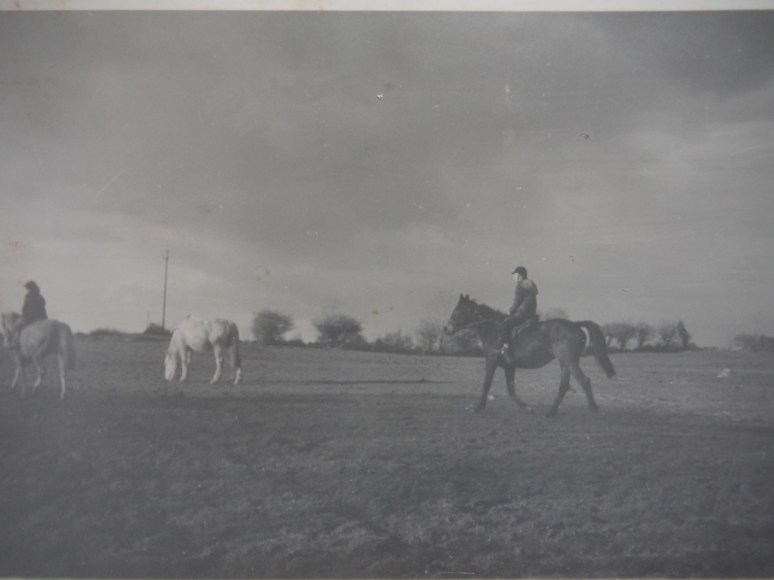
TWO
First horse, Trixie, aka Thundering Bitch. A lot of this was necessary before I would get on her back.
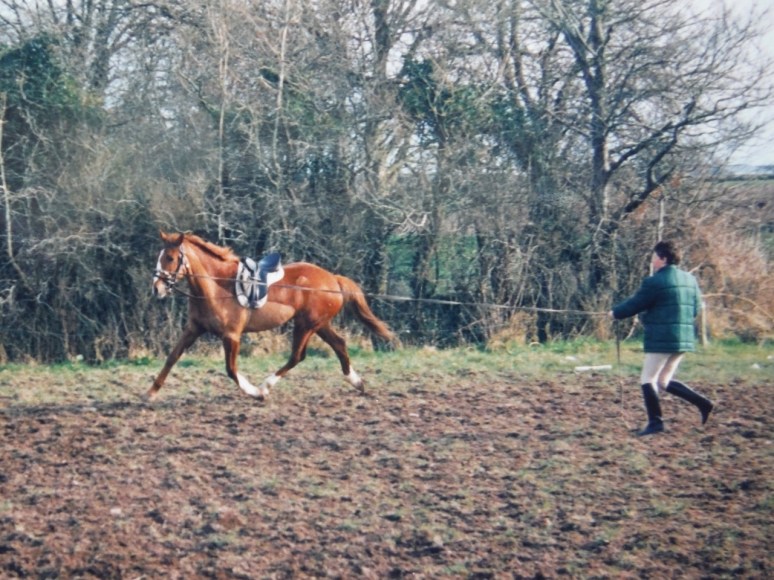
THREE
Again, First Horse. Proof that getting on her back did actually happen. But oh, she was pretty.
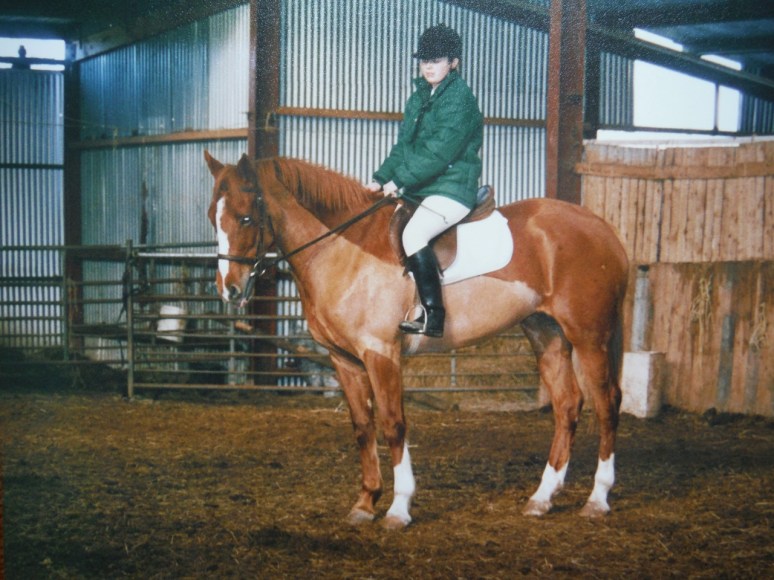
FOUR
First Horse and Mizzen, who undid all her damage.
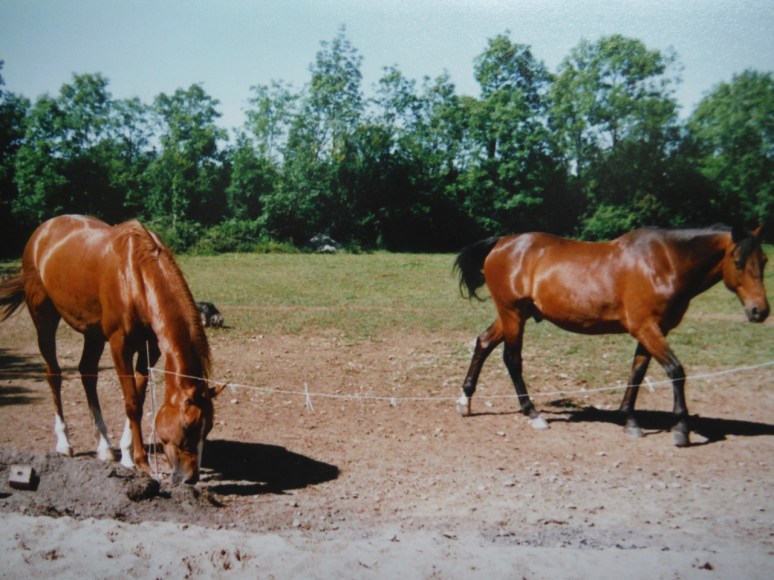
FIVE
How I raised my kids, Part 1
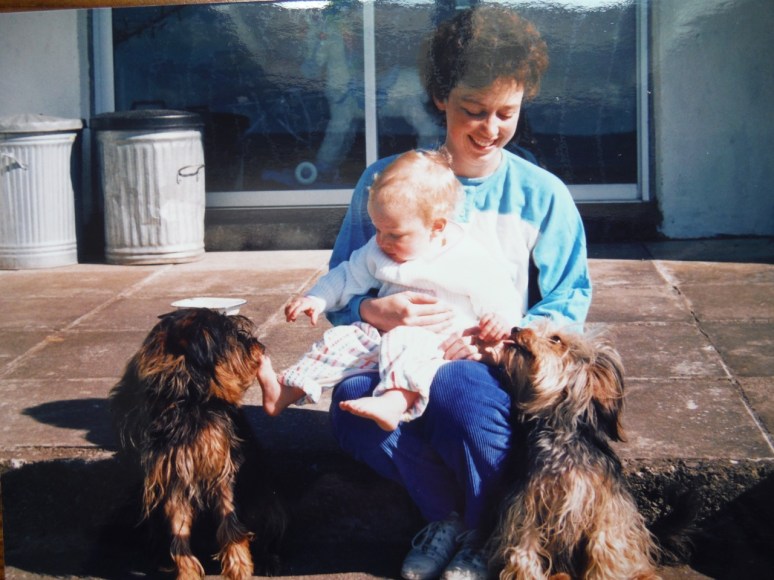
SIX
How I raised my kids, Part 2
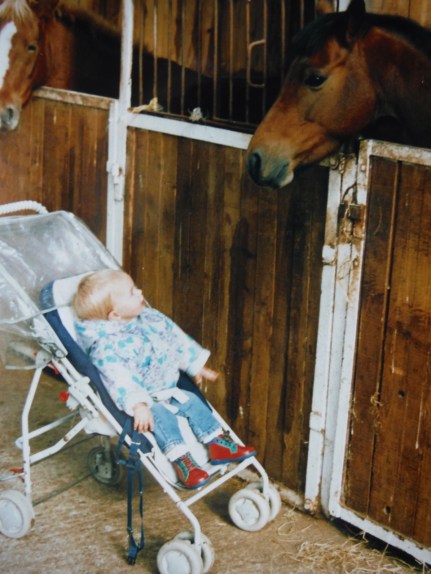
SEVEN
How I raised my kids, Part 3
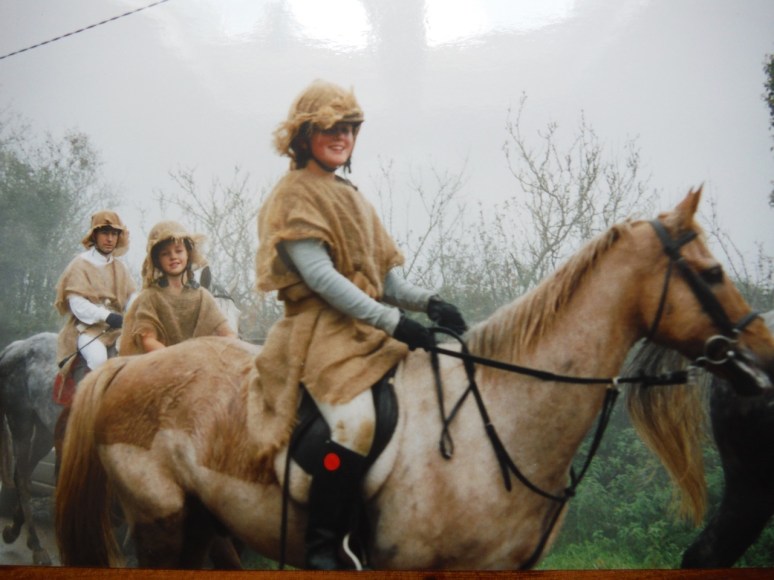
EIGHT
First photo of me and this Dude
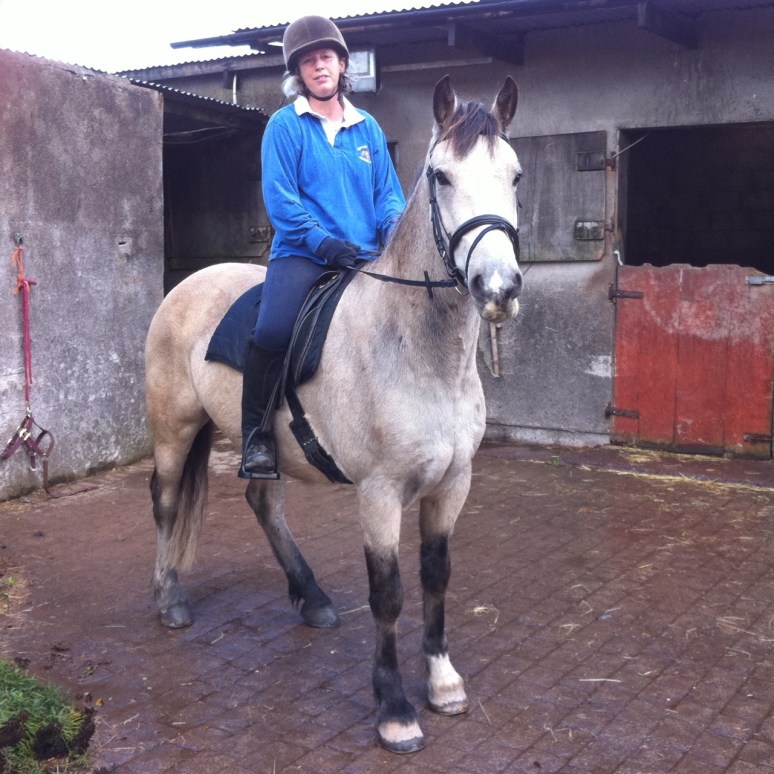
NINE
How I raised my kids part 4. Also an early photo of The Handsome Boy, back when he was a showjumper, before he became an eventer, a dressage horse and finally an Old Lady horse.
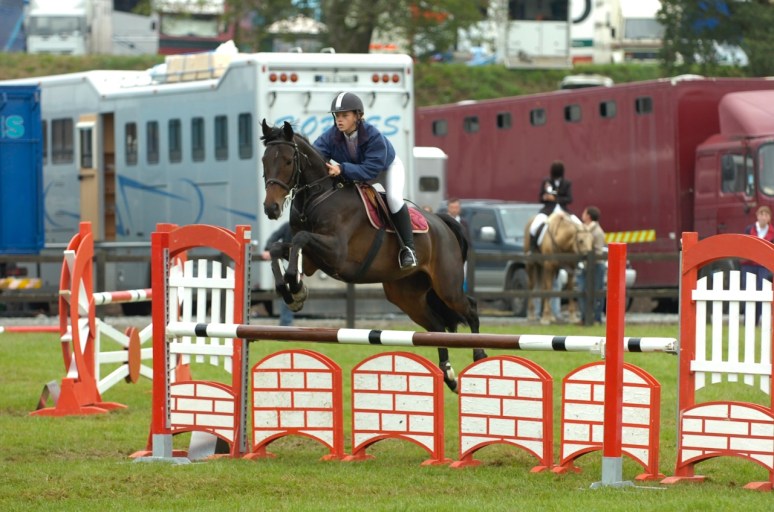
TEN

Thanks, Rodney’s Saga! This was fun.
Have a look at my Art!


Commissions


 Tails From Provence