Tails From Provence
What happens when a horsemad Ould Wagon moves from Cork to Provence with 2 horses, 2 dogs and a Long Suffering Husband? Why, she gets a third dog, discovers Natural Horsemanship à la Française, starts writing short stories and then discovers a long-buried talent for art, of course…

Sarcoids. Ugh.
Aero has had this on the inside of his left thigh for ages :

I knew all along what it was – a “flat” or “occult” sarcoid – but it wasn’t growing or showing any signs of ulcerating, so I hoped that it would stay dormant and not cause any trouble.
When the Osteopath was here two weeks ago, I noticed a little light-coloured bump in his jawline as he stretched out his head and neck during treatment. Was it a big fat tick?
No such luck. It was a small fibroblastic sarcoid.

My friend Sami over at HayNet wrote a really good article on sarcoids last year – you can read it here – but in a nutshell, sarcoids are caused by a virus – a bit like ordinary warts, but much more severe.
I first met sarcoids in a riding school livery pony years and years ago. Max had big, ugly, ulcerated sarcoids. There was one site near his ears and another between his front legs which kept causing trouble – the headpiece of the bridle irritated the one by his ears, and sometimes the one between his legs grew until it reached the girth-line – the biggest I ever saw it was about the size of a large man’s hand. His owners had them treated surgically from time to time, but they invariably came back.
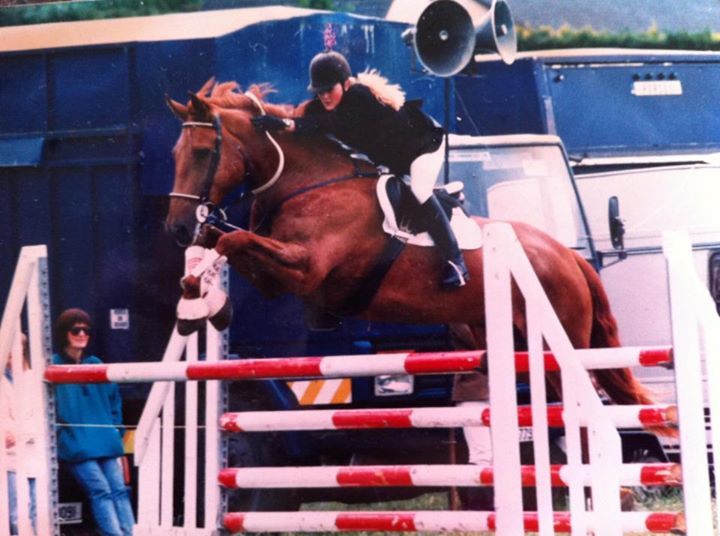
Alf
Our first horse, Trixie, popped up a sarcoid about a year after we bought her. It was a nodular sarcoid – it stayed under the skin, with a covering of hair – and it grew to about the size of a golf-ball before we had it surgically removed. Trixie was WAY too much horse for anyone’s first horse and the sarcoid was the last straw – we sold her shortly afterwards.
One of the earliest clients in my livery yard was a strapping Irish Draught gelding called Alf. Poor old Alf was plagued with sarcoids all his life, but despite this, he was an outstanding show-jumper and even jumped in a couple of international classes at Millstreet Show. His owner used to keep on top of the sarcoids herself by tying them off with rubber bands (the ones used for castrating lambs). This, along with surgery a couple of times, kept them under control, but every year there was a fresh batch to treat.
I’ve also seen sarcoids treated with various toxic creams which caused the area surrounding the sarcoid to swell dramatically and eventually rupture, with the sarcoid basically falling out, hopefully dead.
The first time I heard of the use of Thuja in treating sarcoids was with my friend Anne’s (yes. Wanderly Wagons Anne) second horse, Dex. When he put up a couple of warty-looking grey bumps, we all peered at them, hoping that they weren’t sarcoids but thinking that they probably were. Anne’s vet prescribed a cytotoxic cream, but another friend, who was into Homeopathy, suggested using Thuja. She did both, reasoning that it wouldn’t do any harm, and the sarcoids quickly responded and dropped off, but she was horrified at the severity of the cytotoxic cream. The following year, Dex put up another suspicious grey bump and she reached straight for the Thuja. Within weeks, the bump had disappeared – coincidence?
I think not. I’ve now heard of several people using Thuja successfully to treat sarcoids, including one horse who had had repeated doses of the cytotoxic cream and repeated surgeries. Thuja seemed to stop the sarcoids immediate return, and by starting a course of treatment the minute she saw any hint of a sarcoid, the owner has managed to keep them at bay ever since. Sami from HayNet also successfully treated her horse Zeb with Thuja – read Part I here and Part 2 here.
I’ve started Aero on a course of Thuja. He’s getting five pills twice a day for five days days, then a break for five days, then start again and repeat until we see an improvement. If this doesn’t work, I’ll go the veterinary route, but I reckon I’ve nothing to lose by trying – and a lot to gain!
I’ll keep you posted.
Hydromagnetology II
Reading everyone’s comments on the last post has caused me to ponder some more. I’ve been extrapolating the theory of Hydromagnetology and I’m beginning to come to a terrible realisation.
Think about all the extreme weather occurring across the globe over the course of the last ten years.
Then think about the current Irish economic situation and the resulting modern day diaspora as the Irish spread across the globe in search of work over the course of the last ten years.
The conclusion is inescapable. The Irish are responsible for Climate Change.
Sorry, World.
Hydromagnetology
I am developing a theory. I call it the theory of hydromagnetology :
When three or more Irish people get together, the hydromagnetological attraction becomes increasingly powerfully, drawing rain-clouds to their vicinity.
Some empirical evidence :
Last October, we basked in sunshine and temperatures in the mid twenties. Then Granny came out for a two-week visit. The rain moved in the day she arrived and departed the day after her.
We all (five of us) went to California for Christmas, bringing the total of Irish people in my sister’s household to somewhere between seven and nine (I’m not sure what nationality her kids are). It rained for the entire two weeks we were there.
This week, Elayne arrived on Tuesday. It rained on and off for the next three days. It even rained in Nice the day we dropped her there for her flight home. Coincidence? I think not.
Irish friends came to visit for the weekend. Obviously, Elayne’s presence during the week had already upset the hydromagnetologism of the region. The influx of another two Irish bodies was too much for the system, causing a veritable waterfall to pour from the sky over the whole region for all of Saturday. Thank goodness, they left today. The forecast for the rest of the week is good UNTIL SATURDAY!
What happens on Saturday? More Irish people are due to arrive – the YD, her BF, my big sister & her hubby. It’s possible that the Big Sister and Hubby will count as American in hydromegnetological terms. Let’s just wait and see how much rain falls next weekend before we attach a definitive label to them.
And with the YD and her BF here until September, I suspect Provençe could have its wettest summer on record.
I hope the French don’t get wind of my hydromagnetological research. They might deport us in order to protect their valuable tourism industry.
Shhhh!
Have a look at my Art!


Commissions


 Tails From Provence